
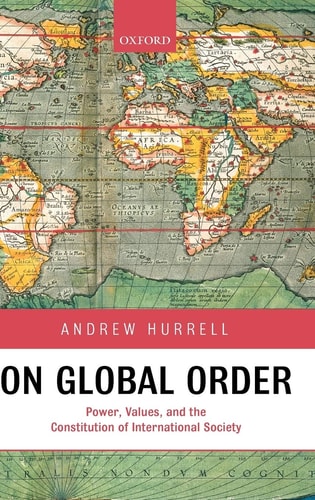
On Global Order: Power, Values, and the Constitution of International Society
0
0
As an Amazon Associate and affiliate partner, Menrva Books earns from qualifying purchases. Learn more
Author Description
How is the world organized politically? How should it be organized? What forms of political organization are required to deal with such global challenges as climate change, terrorism, or nuclear proliferation? Drawing on work in international law, international relations, and global governance, this book provides a clear and wide-ranging introduction to the analysis of global political order -- how patterns of governance and institutionalization in world politics have already changed; what the most important challenges are; and what the way forward might look like. The first section develops three analytical frameworks: a world of sovereign states capable of only limited cooperation; a world of ever-denser international institutions embodying the idea of an international community; and a world in which global governance moves beyond the state and into the realms of markets, civil society and networks. Part II examines five of the most important issues facing contemporary international society: nationalism and the politics of identity; human rights and democracy; war, violence and collective security; the ecological challenge; and the management of economic globalization in a highly unequal world. Part III considers the idea of an emerging multi-regional system; and the picture of global order built around US empire. The conclusion looks at the normative implications. If international society has indeed been changing in the ways discussed in this book, what ought we to do? And, still more crucially, who is the 'we' that is to be at the centre of this drive to create a morally better world? This book is concerned with the fate of international society in an era of globalization and the ability of the inherited society of sovereign states to provide a practically viable and normatively acceptable framework for global political order. It lays particular emphasis on the different forms of global inequality and the problems of legitimacy that these create and on the chall
Menrva's Summary
THE THESIS
How can the inherited system of sovereign states effectively address the complex challenges of global governance in an era of intense globalization? Andrew Hurrell, a prominent scholar in international relations, synthesizes perspectives from international law and political theory to evaluate the legitimacy and viability of current global political structures. He argues that the tension between state sovereignty and the need for collective action requires a nuanced understanding of how power, values, and institutions interact on a global scale.
THE SCOPE MAP
What You Will Find
- Three analytical frameworks: sovereign state cooperation, institutionalized international community, and non-state global governance networks.
- Analysis of five critical issues: nationalism, human rights, collective security, ecological sustainability, and economic inequality.
- Examination of the multi-regional system and the influence of US hegemony.
Scope Limits
- The text does not provide a prescriptive policy manual for specific diplomatic crises.
- It does not offer a comprehensive history of every international organization, focusing instead on the conceptual architecture of global order.
THE AUTHORITY PERSPECTIVE
Experts recognize this work as a foundational text for understanding the structural evolution of international society. Readers frequently note the academic density of the prose, which is well-suited for advanced students and practitioners of international relations.
Page Count:
354
Publication Date:
2008-01-01
Publisher:
Oxford University Press
ISBN-10:
0191528439
ISBN-13:
9780191528439
Political Theory
International Law
International relations
Globalization
Community Tags
Other Editions(3)
Similar Books
Reader Comments
Share Your Thoughts
No comments yet. Be the first to share your thoughts!