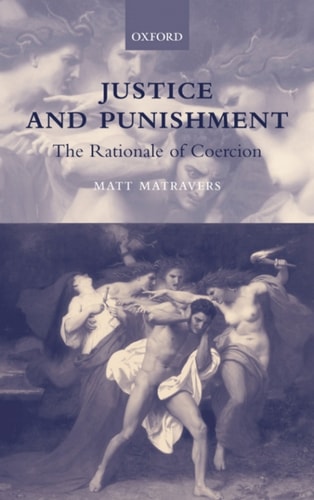
Justice and Punishment: The Rationale of Coercion
0
0
As an Amazon Associate and affiliate partner, Menrva Books earns from qualifying purchases. Learn more
Author Description
This book aims to answer the question: 'why, and by what right do some people punish others?' The author argues that the justification of punishment must be embedded in a substantive political and moral theory. Matravers questions why it is that recent theories of distributive justice have had so little to say about the punishment and retributive justice. His answer is that contemporary theories of justice cannot explain the relationship of justice and morality more broadly conceived. As this is also the relationship that a theory of punishment needs to explain, it is in examining the problem of punishment that the limitations of contemporary theories of justice are most starkly exposed. Moreover, the limitations are such as to undermine these accounts of justice. The claim is that it is through the discussion of punishment that the inadequacies of contemporary theories of justice is demonstrated and it is therefore through the discussion of punishment that those inadequacies can be rectified. Matravers argues for a genuinely constructivist account of morality-constructivist in that it rejects any idea of objective, mind-independent moral values, and seeks instead to construct morality from non-moral human concerns and human wills, and genuinely constructivist in that, in contrast to the faux constructivisim of Rawls and cognate approaches, it does not take as a premise the equal moral worth of persons. He argues that a genuine constructivism will show the need for and justification of punishment as intrinsic to morality itself.
Menrva's Summary
THE THESIS
This book investigates the fundamental moral and political justification for the state's right to impose punishment on individuals. Matt Matravers, a scholar in political philosophy, critiques the silence of contemporary distributive justice theories regarding retributive justice. He argues that these existing frameworks fail to account for the broader relationship between justice and morality, proposing instead a constructivist model that derives moral authority from human concerns and wills rather than objective, mind-independent values.
THE SCOPE MAP
What You Will Find
- A critique of Rawlsian and cognate constructivist approaches to justice.
- An exploration of the intersection between political theory and penal philosophy.
- A defense of a constructivist account of morality that rejects the premise of equal moral worth as a starting point.
Scope Limits
- The text does not provide a practical policy guide for criminal justice reform.
- It does not offer an exhaustive historical survey of penal systems.
THE AUTHORITY PERSPECTIVE
Scholars in political philosophy frequently note the high level of academic rigor and the challenging nature of Matravers' constructivist argument. The text is widely regarded as a significant contribution to the debate on the limitations of contemporary theories of justice.
Page Count:
304
Publication Date:
2000-01-01
Publisher:
OUP Oxford
ISBN-10:
0191522554
ISBN-13:
9780191522550
Philosophy
Punishment
Ethics
Fairness
Political Theory
Jurisprudence