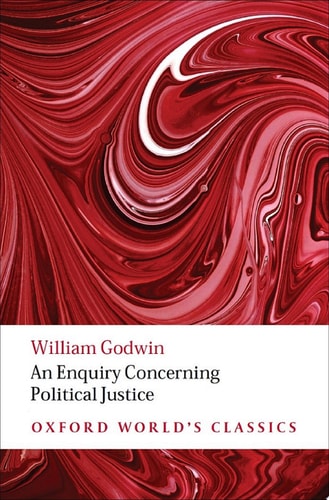
An Enquiry Concerning Political Justice
0
0
As an Amazon Associate and affiliate partner, Menrva Books earns from qualifying purchases. Learn more
Author Description
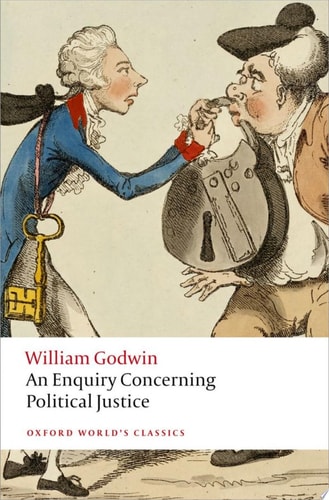
'To a rational being there can be but one rule of conduct, justice, and one mode of ascertaining that rule, the exercise of his understanding.' Godwin's Political Justice is the founding text of philosophical anarchism. Written in the immediate aftermath of the French Revolution, it exemplifies the political optimism felt by many writers and intellectuals. Godwin drew on enlightenment ideas and his background in religious dissent for the principles of justice, utility, and the sanctity of individual judgement that drove his powerful critique of all forms of secular and religious authority. He predicts the triumph of justice and equality over injustice, and of mind over matter, and the eventual vanquishing of human frailty and mortality. He also foresees the gradual elimination of practices governing property, punishment, law, and marriage and the displacement of politics by an expanded personal morality resulting from reasoned argument and candid discussion. Political Justice raises deep philosophical questions about the nature of our duty to others that remain central to modern debates on ethics and politics. This edition reprints the first-edition text of 1793, and examines Godwin's evolving philosophy in the context of his life and work. ABOUT THE SERIES: For over 100 years Oxford World's Classics has made available the widest range of literature from around the globe. Each affordable volume reflects Oxford's commitment to scholarship, providing the most accurate text plus a wealth of other valuable features, including expert introductions by leading authorities, helpful notes to clarify the text, up-to-date bibliographies for further study, and much more.
Menrva's Summary
THE THESIS
Can human society be organized entirely through the exercise of individual reason and justice, rendering traditional government and coercive institutions obsolete? William Godwin, a prominent English political philosopher and novelist, constructs a rigorous argument for philosophical anarchism by synthesizing Enlightenment rationalism with the principles of utility. He posits that the perfection of human society is inevitable as individuals increasingly rely on candid discussion and private judgment rather than the dictates of secular or religious authority.
THE SCOPE MAP
What You Will Find
- A comprehensive critique of property, law, marriage, and punishment as instruments of state control.
- The foundational framework for philosophical anarchism and individualist ethics.
- An analysis of the relationship between mind and matter in the context of human progress.
Scope Limits
- The text focuses on the 1793 first-edition arguments and does not cover the entirety of Godwin's later revisions or shifts in thought.
- It does not provide a practical manual for immediate political revolution, focusing instead on theoretical and moral evolution.
THE AUTHORITY PERSPECTIVE
Scholars and historians recognize this work as the seminal text of philosophical anarchism, noting its significant influence on radical political thought during the late 18th century. Readers frequently observe that the prose is dense and highly academic, requiring careful attention to Godwin's specific definitions of justice and utility.
Page Count:
560
Publication Date:
2013-01-01
Publisher:
OUP Oxford
ISBN-10:
0191662224
ISBN-13:
9780191662225
Philosophy
Ethics
Political Theory
English & College Success
Anarchism
English
Enlightenment