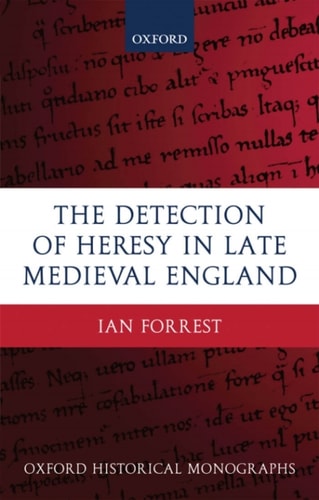
The Detection of Heresy in Late Medieval England
0
0
As an Amazon Associate and affiliate partner, Menrva Books earns from qualifying purchases. Learn more
Author Description
Heresy was the most feared crime in the medieval moral universe. It was seen as a social disease capable of poisoning the body politic and shattering the unity of the church. The study of heresy in late medieval England has, to date, focused largely on the heretics. In consequence, we know very little about how this crime was defined by the churchmen who passed authoritative judgement on it. By examining the drafting, publicizing, and implementing of new laws against heresy in the fourteenth and fifteenth centuries, using published and unpublished judicial records, this book presents the first general study of inquisition in medieval England. In it Ian Forrest argues that because heresy was a problem simultaneously national and local, detection relied upon collaboration between rulers and the ruled. While involvement in detection brought local society into contact with the apparatus of government, uneducated laymen still had to be kept at arm's length, because judgements about heresy were deemed too subtle and important to be left to them. Detection required bishops and inquisitors to balance reported suspicions against canonical proof, and threats to public safety against the rights of the suspect and the deficiencies of human justice. At present, the character and significance of heresy in late medieval England is the subject of much debate. Ian Forrest believes that this debate has to be informed by a greater awareness of the legal and social contexts within which heresy took on its many real and imagined attributes.
Menrva's Summary
THE THESIS
This book investigates how the ecclesiastical and secular authorities in late medieval England defined, detected, and prosecuted heresy as a perceived threat to the social and religious order. Ian Forrest, a historian specializing in medieval society, utilizes a combination of published and unpublished judicial records to analyze the legal frameworks of the fourteenth and fifteenth centuries. He argues that the detection of heresy was a collaborative effort between national government and local communities, requiring a delicate balance between canonical law and the practicalities of local governance.
THE SCOPE MAP
What You Will Find
- Analysis of the drafting and implementation of anti-heresy legislation in the 14th and 15th centuries.
- Examination of the collaborative relationship between bishops, inquisitors, and local lay society.
- Use of primary source judicial records to reconstruct the mechanics of inquisition.
Scope Limits
- The study focuses primarily on the institutional and legal definitions of heresy rather than the theological beliefs of the heretics themselves.
- It does not provide an exhaustive biography of individual heretics, focusing instead on the apparatus of detection.
THE AUTHORITY PERSPECTIVE
Scholars recognize this work as a significant contribution to the study of medieval legal and social history, particularly for its focus on the administrative side of heresy trials. Readers frequently note the academic density of the prose, which is intended for an audience familiar with medieval ecclesiastical and legal structures.
Page Count:
282
Publication Date:
2005-01-01
Publisher:
Clarendon Press
ISBN-10:
0191536873
ISBN-13:
9780191536878
History
Lollards
European History
Academic
Heresy
England
Religious History
Legal History
Community Tags
Other Editions(3)

Similar Books