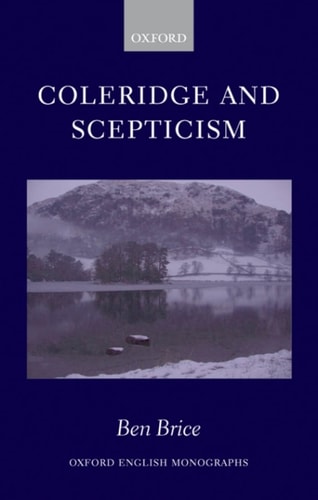
Coleridge and Scepticism
0
0
As an Amazon Associate and affiliate partner, Menrva Books earns from qualifying purchases. Learn more
Author Description
Coleridge tended to view objects in the natural world as if they were capable of articulating truths about his own poetic psyche. He also regarded such objects as if they were capable of illustrating and concretely embodying truths about a transcendent spiritual realm. After 1805, he posited a series of analogical 'likenesses' connecting the rational principles that inform human cognition with the rational principles that he believed informed the teleological structure of the natural world. Human reason and the principle of rationality realised objectively in Nature were both regarded as finite effects of God's seminal Word. Although Coleridge intuitively felt that nature had been constructed as a 'mirror' of the human mind, and that both mind and nature were 'mirrors' of a transcendent spiritual realm, he never found an explanation of such experiences that was fully immune to his own sceptical doubts. Coleridge and Scepticism examines the nature of these sceptical doubts, as well as offering a new explanatory account of why Coleridge was unable to affirm his religious intuitions. Ben Brice situates his work within two important intellectual traditions. The first, a tradition of epistemological 'piety' or 'modesty', informs the work of key precursors such as Kant, Hume, Locke, Boyle, and Calvin, and relates to Protestant critiques of natural reason. The second, a tradition of theological voluntarism, emphasises the omnipotence and transcendence of God, as well as the arbitrary relationship subsisting between God and the created world. Brice argues that Coleridge's detailed familiarity with both of these interrelated intellectual traditions, ultimately served to undermine his confidence in his ability to read the symbolic language of God in nature.
Menrva's Summary
THE THESIS
This book investigates the fundamental tension between Samuel Taylor Coleridge's religious intuitions and his persistent sceptical doubts regarding the symbolic interpretation of nature. Ben Brice, a scholar of Romantic literature and intellectual history, utilizes a rigorous analysis of Coleridge's philosophical writings to demonstrate how his engagement with specific theological and epistemological traditions hindered his ability to affirm his spiritual beliefs. The author argues that Coleridge's deep familiarity with Protestant critiques of natural reason and theological voluntarism ultimately destabilized his confidence in reading the natural world as a divine language.
THE SCOPE MAP
What You Will Find
- An examination of the epistemological tradition of 'piety' or 'modesty' as influenced by Kant, Hume, Locke, Boyle, and Calvin.
- An analysis of theological voluntarism and its emphasis on the transcendence of God.
- A detailed study of Coleridge's post-1805 philosophical development and his attempts to connect human cognition with the teleological structure of nature.
Scope Limits
- The text focuses primarily on the intersection of scepticism and theology in Coleridge's work rather than a comprehensive biography of the poet.
- It does not provide an exhaustive survey of all Romantic-era poets, concentrating specifically on Coleridge's unique intellectual trajectory.
THE AUTHORITY PERSPECTIVE
Scholars and critics recognize this work as a significant contribution to the study of Coleridge's philosophical and theological development. Readers frequently note the academic density of the prose, which is intended for those with a background in intellectual history and Romantic studies.
Page Count:
224
Publication Date:
2007-01-01
Publisher:
Clarendon Press
ISBN-10:
0191537322
ISBN-13:
9780191537325
Philosophy
Literary Criticism
English & College Success
Theology
English
Intellectual History
Romanticism
Community Tags
Similar Books