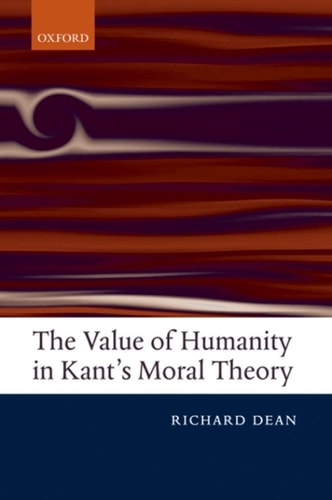
The Value of Humanity in Kant's Moral Theory
0
0
As an Amazon Associate and affiliate partner, Menrva Books earns from qualifying purchases. Learn more
Author Description
The humanity formulation of Kant's Categorical Imperative demands that we treat humanity as an end in itself. Because this principle resonates with currently influential ideals of human rights and dignity, contemporary readers often find it compelling, even if the rest of Kant's moral philosophy leaves them cold. Moreover, some prominent specialists in Kant's ethics recently have turned to the humanity formulation as the most theoretically central and promising principle of Kant's ethics. Nevertheless, despite the intuitive appeal and the increasingly recognized philosophical importance of the humanity formulation, it has received less attention than many other, less central, aspects of Kant's ethics. Richard Dean offers the most sustained and systematic examination of the humanity formulation to date. Dean argues that the 'rational nature' that must be treated as an end in itself is not a minimally rational nature, consisting of the power to set ends or the unrealized capacity to act morally, but instead is the more properly rational nature possessed by someone who gives priority to moral principles over any contrary impulses. This non-standard reading of the humanity formulation provides a firm theoretical foundation for deriving plausible approaches to particular moral issues - and, contrary to first impressions, does not impose moralistic demands to pass judgment on others' character. Dean's reading also enables progress on problems of interest to Kant scholars, such as reconstructing Kant's argument for accepting the humanity formulation as a basic moral principle, and allows for increased understanding of the relationship between Kant's ethics and supposedly Kantian ideas such as 'respect for autonomy'.
Menrva's Summary
THE THESIS
How should one interpret the 'humanity formulation' of Kant's Categorical Imperative to provide a coherent foundation for moral theory? Richard Dean, a specialist in Kantian ethics, evaluates the humanity formulation as the central principle of Kant's moral philosophy. He challenges standard interpretations by arguing that 'rational nature' refers specifically to the capacity to prioritize moral principles over contrary impulses, rather than a minimal capacity to set ends. This systematic examination aims to reconcile Kantian ethics with contemporary ideals of human dignity and autonomy.
THE SCOPE MAP
What You Will Find
- A systematic reconstruction of the humanity formulation of the Categorical Imperative.
- A non-standard interpretation of 'rational nature' as a moralized capacity.
- Analysis of the relationship between Kantian ethics and modern concepts of autonomy.
Scope Limits
- The text does not provide a general introduction to Kant's entire philosophical system.
- It does not focus on the historical reception of Kant's work outside of specialized ethical discourse.
THE AUTHORITY PERSPECTIVE
Scholars recognize this work as a significant contribution to the study of Kantian ethics, particularly for its rigorous defense of a non-standard interpretation of the humanity formulation. Readers frequently note the academic density of the prose, which is intended for those with a background in moral philosophy.
Page Count:
288
Publication Date:
2006-01-01
Publisher:
Clarendon Press
ISBN-10:
0191536571
ISBN-13:
9780191536571
Philosophy
Academic
Kant
Human rights
Ethics
Moral Theory
History & Surveys