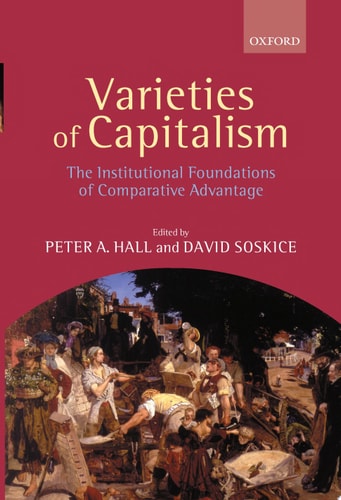
Varieties of Capitalism: The Institutional Foundations of Comparative Advantage
0
0
As an Amazon Associate and affiliate partner, Menrva Books earns from qualifying purchases. Learn more
Author Description
What Are The Most Fundamental Differences Among The Political Economies Of The Developed World? How Do National Institutional Differences Condition Economic Performance, Public Policy, And Social Well-being? Will They Survive The Pressures For Convergence Generated By Globalization And Technological Change? These Have Long Been Central Questions In Comparative Political Economy. This Book Provides A New And Coherent Set Of Answers To Them. Building On The New Economics Of Organization, The Authors Develop An Important New Theory About Which Differences Among National Political Economies Are Most Significant For Economic Policy And Performance. Drawing On A Distinction Between 'liberal' And 'coordinated' Market Economies, They Argue That There Is More Than One Path To Economic Success. Nations Need Not Converge To A Single Anglo-american Model. They Develop A New Theory Of 'comparative Institutionaladvantage' That Transforms Our Understanding Of International Trade, Offers New Explanations For The Response Of Firms And Nations To The Challenges Of Globalization, And Provides A New Theory Of National Interest To Explain The Conduct Of Nations In International Relations. The Analysis Brings The Firm Back Into The Centre Of Comparative Political Economy. It Provides New Perspectives On Economic And Social Policy-making That Illuminate The Role Of Business In The Development Of The Welfare State And The Dilemmas Facing Those Who Make Economic Policy In The Contemporary World. Emphasizing The 'institutional Complementarities' That Link Labour Relations, Corporate Finance, And National Legal Systems, The Authors Bring Interdisciplinary Perspectives To Bear On Issues Of Strategic Management, Economic Performance, And Institutional Change. This Pathbreaking Work Sets New Agendas In The Study Of Comparative Political Economy. As Such, It Will Be Of Value To Academics And Graduate Students In Economics, Business, And Political Science, As Well As To Many Others With Interests
Menrva's Summary
THE THESIS
This book investigates the fundamental institutional differences among developed political economies and how these variations dictate economic performance and policy outcomes. Authors Peter A. Hall and David Soskice, both prominent scholars in political science and economics, utilize the framework of the 'new economics of organization' to challenge the assumption that all nations must converge toward a single Anglo-American model. They argue that distinct institutional arrangements create 'comparative institutional advantage,' allowing different types of market economies to achieve success through varied strategic paths.
THE SCOPE MAP
What You Will Find
- A binary classification system distinguishing between 'liberal market economies' and 'coordinated market economies.'
- Analysis of institutional complementarities linking labor relations, corporate finance, and legal systems.
- A firm-centered approach to understanding national economic strategy and international trade.
Scope Limits
- The text focuses primarily on developed nations and does not provide an extensive analysis of developing or emerging economies.
- It does not offer prescriptive policy solutions for individual nations but rather an analytical framework for understanding institutional behavior.
THE AUTHORITY PERSPECTIVE
Experts widely recognize this work as a foundational text in comparative political economy that successfully shifted the focus of the field back to the firm. Readers frequently note the academic density of the prose, which is intended for graduate-level study and professional research in economics and political science.
Page Count:
562
Publication Date:
2001-01-01
Publisher:
Oxford University Press, Incorporated
ISBN-10:
0191530107
ISBN-13:
9780191530104
Economics
International relations
Special Topics
International Competition
Community Tags
Similar Books













Reader Comments
Share Your Thoughts
No comments yet. Be the first to share your thoughts!