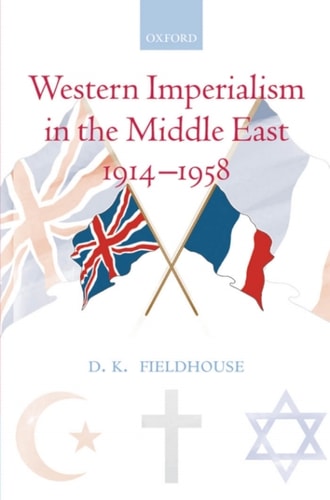
Western Imperialism in the Middle East: 1914-1958
0
0
As an Amazon Associate and affiliate partner, Menrva Books earns from qualifying purchases. Learn more
Author Description
The term 'Fertile Crescent' is commonly used as shorthand for the group of territories extending around the Rivers Tigris and Euphrates. Here it is assumed to consist of Syria, Lebanon, Jordan, Iraq and Palestine. Much has been written on the history of these countries which were taken from the Ottoman empire after 1918 and became Mandates under the League of Nations. For the most part the histories of these countries have been handled either individually or as part of the history of Britain or France. In the first instance the emphasis has normally been on the development of nationalism and local resistance to alien control in a particular territory, leading to the modern successor state. In the second most studies have concentrated separately on how either France or Britain handled the great problems they inherited, seldom comparing their strategies. The aim of this book is to see the region as a whole and from both the European and indigenous points of view. The central argument is that the mandate system failed in its stated purpose of establishing stable democratic states out of what had been provinces or parts of provinces within the Ottoman empire. Rather it generated basically unstable polities and, in the special case of Palestine, one totally unresolved, and possibly unsolvable, conflict. The result was to leave the Middle East as perhaps the most volatile part of the world in the later twentieth century and beyond. The main purpose of the book is to examine why this was so.
Menrva's Summary
THE THESIS
This book investigates why the mandate system in the Fertile Crescent failed to establish stable democratic states and instead fostered regional volatility. D. K. Fieldhouse, a noted historian of imperialism, utilizes a comparative framework to analyze the administrative strategies of Britain and France in the region. By synthesizing European policy decisions with indigenous responses, the author argues that the structural imposition of mandates created inherently unstable political entities that persisted long after the colonial era concluded.
THE SCOPE MAP
What You Will Find
- Comparative analysis of British and French mandate administration in Syria, Lebanon, Jordan, Iraq, and Palestine.
- Examination of the transition from Ottoman provincial governance to Western-mandated successor states.
- Evaluation of the failure of democratic institution-building in the post-1918 period.
Scope Limits
- The text focuses primarily on the mandate period between 1914 and 1958 and does not provide an exhaustive history of the region beyond the mid-twentieth century.
- It does not cover the internal histories of these nations in isolation, prioritizing the regional impact of imperial policy.
THE AUTHORITY PERSPECTIVE
Scholars and historians frequently cite this work as a foundational comparative study for understanding the structural origins of Middle Eastern instability. Readers often note the academic rigor of the prose and the author's ability to synthesize complex geopolitical data into a coherent regional narrative.
Page Count:
400
Publication Date:
2006-01-01
Publisher:
Oxford University Press
ISBN-10:
0191536962
ISBN-13:
9780191536960
History
Middle Eastern
20th Century
International relations
Mandates
Europe
Colonialism
Middle East
Community Tags
Similar Books