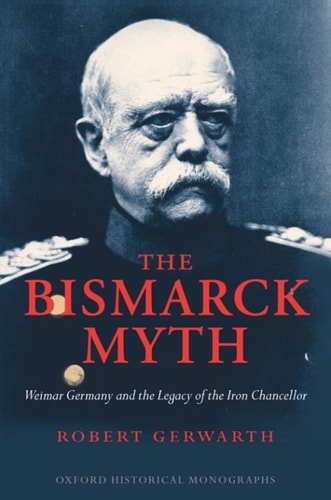
The Bismarck Myth: Weimar Germany and the Legacy of the Iron Chancellor
0
0
As an Amazon Associate and affiliate partner, Menrva Books earns from qualifying purchases. Learn more
Author Description
Few statesmen in history have inspired the imagination of generations of Germans more than the founder of the Kaiserreich, Otto von Bismarck. The archetype of charismatic leadership, the Iron Chancellor maintained his pre-eminent position in the pantheon of Germany's political iconography for much of the twentieth century. Based on a large selection of primary sources, this book provides an insightful analysis of the Bismarck myth's profound impact on Germany's political culture. In particular, it investigates the ways in which that myth was used to undermine parliamentary democracy in Germany after the Great War, paving the way for its replacement by authoritarian rule under an allegedly 'Bismarckian' charismatic leader, Adolf Hitler. As one of the most powerful weapons of nationalist agitation against the Weimar Republic, the Bismarck myth was never contested. The nationalists' ideologically charged interpretation of Bismarck as the father of the German nation-state and model for future political decision-making clashed with rivalling - and thoroughly critical - democratic and communist perceptions of the Iron Chancellor. The quarrel over Bismarck's legacy demonstrates how the clash of ideologies, particularly between 1918 and 1933, resulted in a highly political fight for the 'correct' and universal interpretation of the German past. Essential reading for anyone interested in modern German history, this book sheds new light on the Weimar Republic's struggle for survival and the reasons for its failure.
Menrva's Summary
THE THESIS
This book investigates how the constructed myth of Otto von Bismarck was utilized as a political instrument to destabilize the Weimar Republic and facilitate the rise of authoritarianism. Robert Gerwarth, a historian specializing in modern German history, draws upon an extensive array of primary sources to examine the ideological battle over Bismarck's legacy. He argues that the nationalist appropriation of the 'Iron Chancellor' as a model for charismatic leadership served to undermine parliamentary democracy, ultimately creating a cultural environment receptive to the rise of Adolf Hitler.
THE SCOPE MAP
What You Will Find
- Analysis of political iconography in twentieth-century Germany
- Examination of the ideological conflict between nationalist, democratic, and communist interpretations of history
- Investigation into the period between 1918 and 1933
- Use of primary source materials including nationalist propaganda and political discourse
Scope Limits
- The study focuses specifically on the myth-making process rather than a comprehensive biography of Bismarck himself
- The analysis is confined primarily to the political culture of the Weimar Republic era
THE AUTHORITY PERSPECTIVE
Historians and scholars of the Weimar period frequently cite this work for its rigorous analysis of how historical memory functions as a political weapon. Experts highlight the text as a significant contribution to understanding the intellectual failures that contributed to the collapse of German democracy.
Page Count:
228
Publication Date:
2005-01-01
Publisher:
Clarendon Press
ISBN-10:
0191535974
ISBN-13:
9780191535970
History
Biographical Studies
German history
Political History
European History
Community Tags
Similar Books