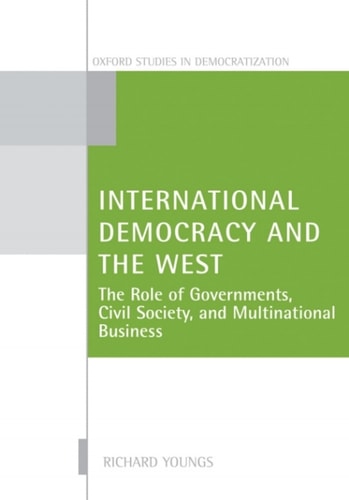
International Democracy and the West: The Role of Governments, Civil Society, and Multinational Business
0
0
As an Amazon Associate and affiliate partner, Menrva Books earns from qualifying purchases. Learn more
Author Description
This book adds to debates over the international dimensions of democratic change by studying the policies and actions of three sets of Western actors: namely, governments, multinational companies, and international NGOs. This actor-based triangular approach responds to observations that the strategic, economic, and social aspects of international democracy have rarely been studied in a combined, holistic fashion. During the 1990s, Western governments, multinational companies, and civil society organizations all came to engage more notably in debates over democratic trends. But were they genuine when they professed a concern with democracy in developing countries? Which of these dynamics - governmental, commercial, or social - was the most influential in propelling efforts to encourage democratization and which helped explain the limits of democracy's international reach? Did political, economic, and social actors form a broad network of international democratic momentum, or did their respective perspectives increasingly diverge? Exploring these questions, the book presents extensive empirical material relating to Western policies in a number of developing regions, covering the period from the mid-1990s to 2003. Oxford Studies in Democratization is a series for scholars and students of comparative politics and related disciplines. Volumes concentrate on the comparative study of the democratization process that accompanied the decline and termination of the cold war. The geographical focus of the series is primarily Latin America, the Caribbean, Southern and Eastern Europe, and relevant experiences in Africa and Asia. The series editor is Laurence Whitehead, Official Fellow, Nuffield College, University of Oxford.
Menrva's Summary
THE THESIS
This book investigates the extent to which Western governments, multinational corporations, and international NGOs have effectively influenced democratic transitions in developing nations. Richard Youngs, a senior fellow at the Carnegie Endowment for International Peace, utilizes a triangular actor-based framework to analyze the strategic, economic, and social motivations behind Western involvement in global democratization. He argues that while these actors often profess a commitment to democratic values, their actual influence is frequently constrained by diverging interests and the limitations of their respective institutional agendas.
THE SCOPE MAP
What You Will Find
- Comparative analysis of Western governmental policies, multinational corporate activities, and NGO interventions.
- Empirical data covering democratic trends and Western influence from the mid-1990s through 2003.
- Evaluation of the synergy and friction between political, economic, and social actors in international development.
Scope Limits
- The analysis is restricted to the period ending in 2003 and does not account for subsequent shifts in global democratic trends.
- The study focuses primarily on Western actors and does not provide an exhaustive account of internal democratic movements within the developing regions themselves.
THE AUTHORITY PERSPECTIVE
Scholars in the field of comparative politics recognize this work as a rigorous examination of the multi-actor dynamics involved in international democracy promotion. Readers frequently note the academic density of the prose and the value of its holistic approach to understanding the limits of Western influence.
Page Count:
232
Publication Date:
2005-01-01
Publisher:
Oxford University Press
ISBN-10:
0191534447
ISBN-13:
9780191534447
International relations
Civil society
Comparative Politics
Globalization
Community Tags
Similar Books