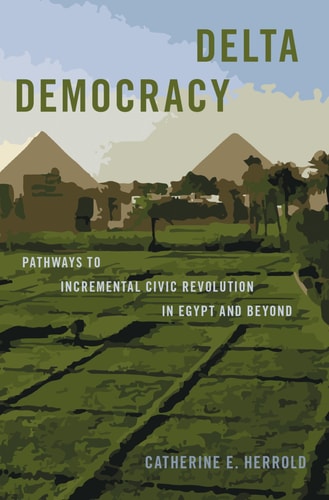
Delta Democracy: Pathways to Incremental Civic Revolution in Egypt and Beyond
0
0
As an Amazon Associate and affiliate partner, Menrva Books earns from qualifying purchases. Learn more
Author Description
The 2011 Arab Spring protests seemed to mark a turning point in Middle East politics, away from authoritarianism and toward democracy. Within a few years, however, most observers saw the protests as a failure given the outbreak of civil wars and re-emergence of authoritarian strongmen in countries like Egypt. But in Delta Democracy, Catherine E. Herrold argues that we should not overlook the ongoing mobilization taking place in grassroots civil society. Drawing upon ethnographic research on Egypt's nongovernmental organizations (NGOs) in the wake of the uprisings, Herrold uncovers the strategies that local NGOs used to build a more democratic and just society. Departing from US-based democracy advocates' attempts to reform national political institutions, local Egyptian organizations worked with communities to build a culture of democracy through public discussion, debate, and collective action. At present, these forms of participatory democracy are more attainable than establishing fair elections or parliaments, and they are helping Egyptians regain a sense of freedom that they have been denied as the long-time subjects of a dictator. Delta Democracy advances our understanding of how civil society organizations maneuver under state repression in order to combat authoritarianism. It also offers a concrete set of recommendations on how US policymakers can restructure foreign aid to better help local community organizations fighting to expand democracy.
Menrva's Summary
THE THESIS
Can grassroots civil society organizations effectively foster democratic change in authoritarian regimes despite the failure of national-level political uprisings? Catherine E. Herrold, a scholar specializing in nonprofit management and civil society, utilizes extensive ethnographic research conducted in Egypt following the 2011 Arab Spring. She argues that while national political institutions have largely reverted to authoritarian control, local nongovernmental organizations are successfully cultivating a culture of participatory democracy through community-level engagement and collective action.
THE SCOPE MAP
What You Will Find
- Ethnographic analysis of Egyptian nongovernmental organizations post-2011.
- Strategies for maneuvering under state-imposed repression and surveillance.
- Policy recommendations for restructuring international foreign aid to support local grassroots initiatives.
Scope Limits
- The study focuses primarily on local NGO dynamics rather than national-level electoral or parliamentary politics.
- The research is geographically centered on Egypt and does not provide an exhaustive comparative analysis of all Arab Spring nations.
THE AUTHORITY PERSPECTIVE
Experts in Middle Eastern politics and development studies recognize this work as a significant contribution to understanding the resilience of civil society under authoritarian rule. Readers frequently note that the text provides a nuanced, grounded alternative to top-down democratization theories by highlighting the importance of local, incremental civic engagement.
Page Count:
224
Publication Date:
2020-01-01
Publisher:
Oxford University Press
ISBN-10:
0190093250
ISBN-13:
9780190093259
Sociology
International relations
Comparative Politics
Middle Eastern
Civil society
Democracy