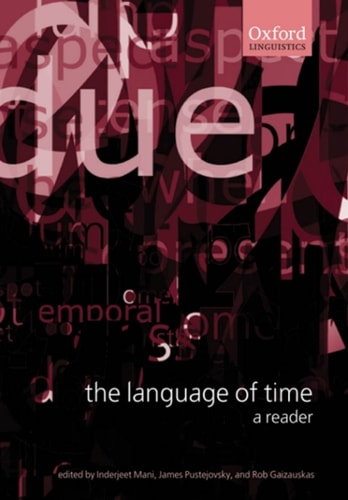
The Language of Time: A Reader
0
0
As an Amazon Associate and affiliate partner, Menrva Books earns from qualifying purchases. Learn more
Author Description
This reader collects and introduces important work in linguistics, computer science, artificial intelligence, and computational linguistics on the use of linguistic devices in natural languages to situate events in time: whether they are past, present, or future; whether they are real or hypothetical; when an event might have occurred, and how long it could have lasted. In focussing on the treatment and retrieval of time-based information it seeks to lay the foundation for temporally-aware natural language computer processing systems, for example those that process documents on the worldwide web to answer questions or produce summaries. The development of such systems requires the application of technical knowledge from many different disciplines. The book is the first to bring these disciplines together, by means of classic and contemporary papers in four areas: tense, aspect, and event structure; temporal reasoning; the temporal structure of natural language discourse; and temporal annotation. Clear, self-contained editorial introductions to each area provide the necessary technical background for the non-specialist, explaining the underlying connections across disciplines. A wide range of students and professionals in academia and industry will value this book as an introduction and guide to a new and vital technology. The former include researchers, students, and teachers of natural language processing, linguistics, artificial intelligence, computational linguistics, computer science, information retrieval (including the growing speciality of question-answering), library sciences, human-computer interaction, and cognitive science. Those in industry include corporate managers and researchers, software product developers, and engineers in information-intensive companies, such as on-line database and web-service providers.
Menrva's Summary
THE THESIS
This volume investigates the computational representation and processing of temporal information within natural language to enable systems that understand event timing, duration, and modality. The authors, experts in computational linguistics and artificial intelligence, curate a collection of foundational and contemporary research papers to bridge the gap between linguistic theory and computer science applications. By synthesizing perspectives from diverse fields, the book establishes a framework for developing systems capable of extracting and reasoning about time-based data in digital documents.
THE SCOPE MAP
What You Will Find
- Research on tense, aspect, and event structure
- Methodologies for temporal reasoning and discourse analysis
- Standards and practices for temporal annotation
- Editorial introductions providing technical context for each section
Scope Limits
- Does not cover general-purpose natural language processing outside of temporal information
- Does not provide source code for specific software implementations
THE AUTHORITY PERSPECTIVE
Experts identify this collection as a foundational resource for researchers and developers working at the intersection of linguistics and information technology. Readers frequently note the academic density of the prose, which serves as a comprehensive guide for those specializing in temporal data processing.
Page Count:
600
Publication Date:
2005-01-01
Publisher:
Oxford University Press
ISBN-10:
0191533300
ISBN-13:
9780191533303
English
Computer Science
Computational linguistics
Information Retrieval
Language Processing
Linguistics
English & College Success
Community Tags
Similar Books