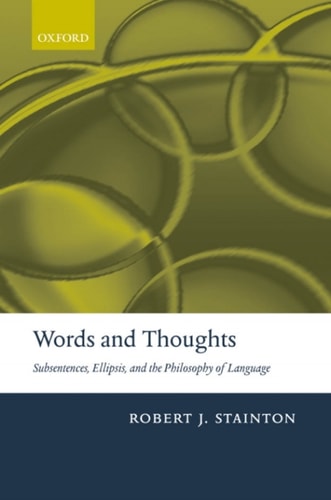
Words and Thoughts: Subsentences, Ellipsis, and the Philosophy of Language
0
0
As an Amazon Associate and affiliate partner, Menrva Books earns from qualifying purchases. Learn more
Author Description
It is a near truism of philosophy of language that sentences are prior to words. Sentences, it is said, are what we believe, assert, and argue for; uses of them constitute our evidence in semantics; only they stand in inferential relations, and are true or false. Sentences are, indeed, the only things that fundamentally have meaning. Does this near truism really hold of human languages? Robert Stainton, drawing on a wide body of evidence, argues forcefully that speakers can and do use mere words, not sentences, to communicate complete thoughts. He then considers the implications of this empirical result for language-thought relations, various doctrines of sentence primacy, and the semantics-pragmatics boundary. The book is important both for its philosophical and empirical claims, and for the methodology employed. Stainton illustrates how the methods and detailed results of the various cognitive sciences can bear on central issues in philosophy of language. At the same time, he applies philosophical distinctions with subtlety and care, to show that arguments which seemingly support the primacy of sentences do not really do so. The result is a paradigm example of The New Philosophy of Language: a rich melding of empirical work with traditional philosophy of language.
Menrva's Summary
THE THESIS
This book investigates whether the traditional philosophical assumption that sentences are the primary units of meaning and communication holds true in the context of human language usage. Robert Stainton, a philosopher of language, challenges the long-standing doctrine of sentence primacy by presenting empirical evidence that speakers frequently communicate complete thoughts using only individual words or subsentential phrases. By integrating findings from cognitive science with traditional linguistic analysis, he argues that the reliance on full sentences as the sole vehicles for truth-conditional content is an oversimplification of how human communication functions in practice.
THE SCOPE MAP
What You Will Find
- Analysis of subsentential speech acts and elliptical constructions.
- Examination of the semantics-pragmatics boundary in linguistic theory.
- Integration of cognitive science data with philosophical argumentation.
- Critique of traditional doctrines regarding sentence primacy.
Scope Limits
- The text does not provide a comprehensive history of all linguistic theories.
- It focuses primarily on the philosophical implications of subsentential communication rather than a general introduction to linguistics.
THE AUTHORITY PERSPECTIVE
Experts in the field recognize this work as a significant contribution to the intersection of empirical cognitive science and analytic philosophy of language. Scholars frequently cite the text for its rigorous methodology and its challenge to established semantic paradigms.
Page Count:
272
Publication Date:
2006-01-01
Publisher:
Clarendon Press
ISBN-10:
0191530549
ISBN-13:
9780191530548
Philosophy
Philosophy of
Mind & Body
Pragmatics
Linguistics
Semantics
Community Tags
Other Editions(2)
Similar Books