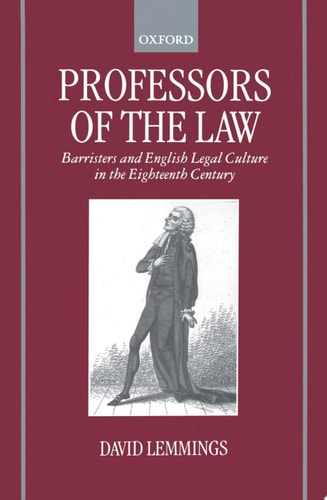
Professors of the Law
0
0
As an Amazon Associate and affiliate partner, Menrva Books earns from qualifying purchases. Learn more
Author Description
What Happened To The Culture Of Common Law And English Barristers In The Long Eighteenth Century? In This Wide-ranging Sequel To Gentlemen And Barristers: The Inns Of Court And The English Bar, 1680-1730, David Lemmings Not Only Anatomizes The Barristers And Their World; He Also Explores The Popular Reputation And Self-image Of The Law And Lawyers In The Context Of Declining Popular Participation In Litigation, Increased Parliamentary Legislation, And The Growth Of The Imperial State. He Shows How The Bar Survived And Prospered In A Century Of Low Recruitment And Declining Work, But Failed To Fulfil The Expectations Of An Age Of Enlightenment And Reform. By Contrast With The Important Role Played By The Common Law, And Lawyers, In Seventeenth-century England And In Colonial America, It Appears That The Culture And Services Of The Barristers Became Marginalized As The Courts Concentrated On Elite Clients, And Parliament Became The Primary Point Of Contact Between Government And Population. In His Conclusion The Author Suggests That The Failure Of The Bar And The Judiciary To Follow Blackstones Mid-century Recommendations For Reforming Legal Culture And Delivering The Englishmans Birthrights Significantly Assisted The Growth Of Parliamentary Absolutism In Government.
Menrva's Summary
THE THESIS
This book investigates the transformation of the English legal profession and the culture of the common law during the long eighteenth century. David Lemmings, a historian specializing in the social history of the law, utilizes extensive archival research and institutional records to analyze the decline of the barrister's public influence. He argues that the legal profession's failure to adapt to the Enlightenment's reformist expectations facilitated the rise of parliamentary absolutism.
THE SCOPE MAP
What You Will Find
- Analysis of the Inns of Court and the professional identity of barristers between 1730 and 1830.
- Examination of the shift from litigation-based legal engagement to parliamentary-focused governance.
- Comparative study of the legal profession's role in England versus colonial America.
- Discussion of the impact of Blackstone's legal recommendations on the judiciary.
Scope Limits
- The study focuses primarily on the English barrister class and does not provide an exhaustive account of lower-level legal practitioners or solicitors.
- The analysis is confined to the long eighteenth century and does not extend into the full scope of Victorian legal reforms.
THE AUTHORITY PERSPECTIVE
Historians and legal scholars frequently cite this work as a definitive study on the professional evolution of the English Bar during a period of significant institutional stagnation. Experts highlight the author's meticulous use of primary sources to explain the disconnect between legal theory and the practical realities of eighteenth-century governance.
Page Count:
414
Publication Date:
2000-01-01
Publisher:
Oup Oxford
ISBN-10:
0191542717
ISBN-13:
9780191542718
History
Law
18th century
British History
Legal History
Community Tags
Similar Books