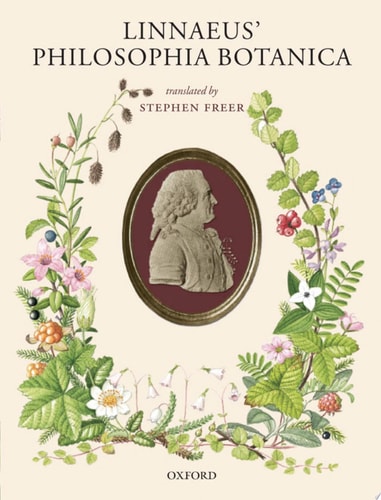
Philosophia Botanica
0
0
As an Amazon Associate and affiliate partner, Menrva Books earns from qualifying purchases. Learn more
Author Description
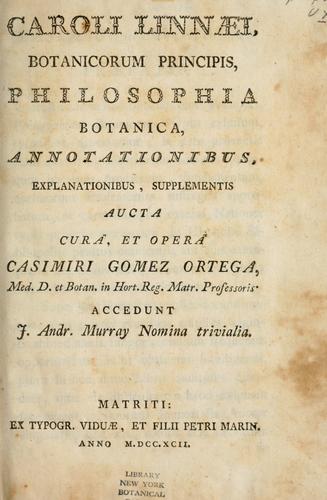
Philosophia Botanica (The Science of Botany), by Carl Linnaeus, was originally published in Latin in Stockholm and Amsterdam in 1751. It is a greatly expanded revision of his Fundamenta Botanica (Foundations of Botany) of 1736, summarizing his work on the classification and taxonomy of plants while adding substantial new material. The book represents a critical stage in the evolution of binomial nomenclature, with a single word to describe the genus and another for the species. Special importance is attached to accurate description of the parts of plants, and to the correct use of technical terms. There are also explanations of the effects of soil and climatic conditions on plant growth. The book includes 10 original engravings, with 167 figures showing the shapes of leaves and other parts of the plant, and 6 short memoranda describing Linnaeus' botanical excursions, detailing his ideas for garden and herbarium construction, and outlining what is required of a botanist and his pupils. There are also indexes of technical terms, genera, and subjects. The first full English translation of this classic work since 1775, this beautiful book will be highly attractive to botanists and all those interested in the history of science.
Menrva's Summary
THE THESIS
How can the chaotic diversity of the plant kingdom be organized into a rigorous, universal system of classification and nomenclature? Carl Linnaeus, a Swedish naturalist and physician, provides a comprehensive framework for botanical study by establishing the principles of binomial nomenclature and morphological description. Drawing upon his earlier work in Fundamenta Botanica, he synthesizes decades of observation to define the structural requirements for identifying, naming, and categorizing flora within a scientific context.
THE SCOPE MAP
What You Will Find
- A foundational system for binomial nomenclature using genus and species identifiers.
- Detailed morphological guidelines for describing plant parts such as leaves and reproductive structures.
- Practical instructions for the construction of herbariums and botanical gardens.
- Observations on the environmental impact of soil and climate on plant development.
Scope Limits
- The text does not account for modern genetic or molecular phylogenetic classification methods.
- It focuses primarily on the taxonomy and structural description of plants rather than physiological or biochemical processes.
THE AUTHORITY PERSPECTIVE
Historians of science and botanists recognize this work as a cornerstone of modern biological classification. Readers frequently note the academic density of the prose, which reflects the formal scientific standards of the eighteenth century.
Page Count:
432
Publication Date:
2003-01-01
Publisher:
Oxford University Press
ISBN-10:
0191544868
ISBN-13:
9780191544866
History
Science
Natural History
Science History
Botany
Plants classification
Earth Sciences
Reference
Taxonomy