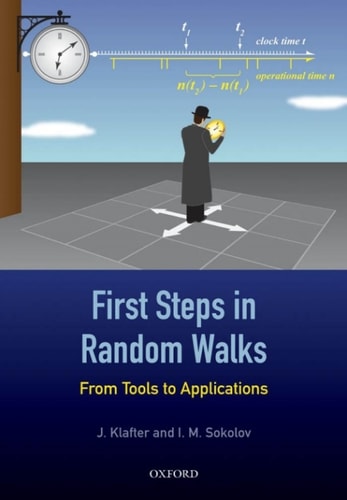
First Steps in Random Walks: From Tools to Applications
0
0
As an Amazon Associate and affiliate partner, Menrva Books earns from qualifying purchases. Learn more
Author Description
The name "random walk" for a problem of a displacement of a point in a sequence of independent random steps was coined by Karl Pearson in 1905 in a question posed to readers of "Nature". The same year, a similar problem was formulated by Albert Einstein in one of his Annus Mirabilis works. Even earlier such a problem was posed by Louis Bachelier in his thesis devoted to the theory of financial speculations in 1900. Nowadays the theory of random walks has proved useful in physics and chemistry (diffusion, reactions, mixing flows), economics, biology (from animal spread to motion of subcellular structures) and in many other disciplines. The random walk approach serves not only as a model of simple diffusion but of many complex sub- and super-diffusive transport processes as well. This book discusses the main variants of random walks and gives the most important mathematical tools for their theoretical description.
Menrva's Summary
THE THESIS
This text investigates the mathematical foundations and diverse applications of random walk theory across various scientific and economic disciplines. Authors I. M. Sokolov and J. Klafter provide a rigorous framework for understanding displacement models, drawing upon historical developments from Pearson, Einstein, and Bachelier. The book synthesizes complex transport processes, ranging from simple diffusion to sub- and super-diffusive phenomena, into a cohesive pedagogical structure.
THE SCOPE MAP
What You Will Find
- Mathematical derivations for various random walk variants
- Applications in physics, chemistry, biology, and economics
- Analysis of sub-diffusive and super-diffusive transport processes
Scope Limits
- Advanced specialized research beyond the foundational scope
- Historical biography of the contributors
THE AUTHORITY PERSPECTIVE
Experts recognize this work as a foundational text for students and researchers entering the field of stochastic processes. Readers frequently note the technical clarity of the prose, which effectively bridges the gap between theoretical probability and practical application.
Page Count:
160
Publication Date:
2011-01-01
Publisher:
OUP Oxford
ISBN-10:
019155295X
ISBN-13:
9780191552953
Science
Earth Sciences
Stochastic processes
Academic
Physics
Mathematical Physics
Probability Theory
Mathematics
Community Tags
Similar Books