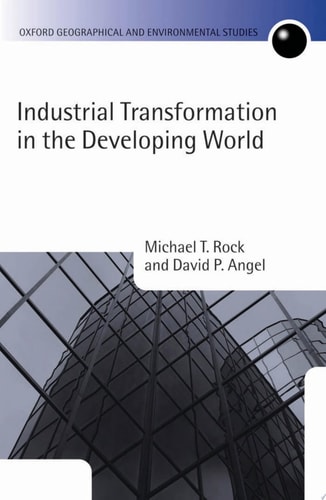
Industrial Transformation in the Developing World
0
0
As an Amazon Associate and affiliate partner, Menrva Books earns from qualifying purchases. Learn more
Author Description
'Grow first, clean up later' environmental strategies in the developing economies of East Asia - China, Korea, and Taiwan in Northeast Asia and Indonesia, Malaysia, the Phillippines, Singapore, Thailand and Vietnam in Southeast Asia - pose a critical regional and global sustainability challenge in this area of continuing rapid urban-based industrial growth. It is the most polluted region in the world. Whilst being at the leading edge of the processes of urbanization, industrialization, and globalization these economies are in the midst, not at the end, of their urban-industrial transformations. During the next 25 years urban populations in the region are expected roughly to double, and most of the industrial capital stock that will be on the ground by 2030 has not yet been built. Given East Asia's growing size in the world's economy and ecology, and its increasingly polluted environment, this looming urban-industrial transformation is both a challenge and an opportunity. Unless steps are taken now to make this transformation more sustainable, East Asia's, and the world's, environmental future is likely to deteriorate seriously. Using detailed case studies and rigorous empirical analyses Rock and Angel, leading experts in this field, show that East Asian governments have found institutionally unique ways to overcome the sustainability challenge. As a result of these findings, they demonstrate how even low income economies in the rest of the world can use regulatory polices, industrial policies, and an openness to trade and foreign investment that will increase the competitiveness of their firms whilst improving their environmental performance, thus proving an important antidote to those who argue that poor countries cannot afford to clean up their environment whilst their economies remain under-developed.
Menrva's Summary
THE THESIS
Can developing economies achieve rapid industrial growth without sacrificing environmental sustainability? Authors David P. Angel and Michael T. Rock, both recognized experts in economic development and environmental policy, examine the 'grow first, clean up later' paradigm prevalent in East and Southeast Asia. They argue that through specific institutional frameworks, regulatory policies, and strategic trade openness, developing nations can decouple industrial expansion from environmental degradation, thereby challenging the assumption that economic growth necessitates ecological collapse.
THE SCOPE MAP
What You Will Find
- Comparative analysis of industrialization in China, Korea, Taiwan, Indonesia, Malaysia, the Philippines, Singapore, Thailand, and Vietnam.
- Empirical data regarding urban population growth and industrial capital stock projections through 2030.
- Frameworks for integrating environmental performance into industrial competitiveness strategies.
Scope Limits
- The text focuses primarily on the East and Southeast Asian regions and does not provide a comprehensive global analysis of all developing nations.
- The study does not address the political feasibility of implementing these policies in non-democratic or highly unstable governance structures.
THE AUTHORITY PERSPECTIVE
Experts in the field of development economics identify this work as a rigorous, data-driven contribution to the discourse on sustainable industrialization. Readers frequently note the academic density of the prose, which serves as a foundational text for policymakers and researchers examining the intersection of trade, regulation, and environmental management.
Page Count:
264
Publication Date:
2005-01-01
Publisher:
OUP Oxford
ISBN-10:
0191556467
ISBN-13:
9780191556463
Economics
Sustainability
Industrial Policy
Geography
Community Tags
Other Editions(2)

Similar Books



Reader Comments
Share Your Thoughts
No comments yet. Be the first to share your thoughts!