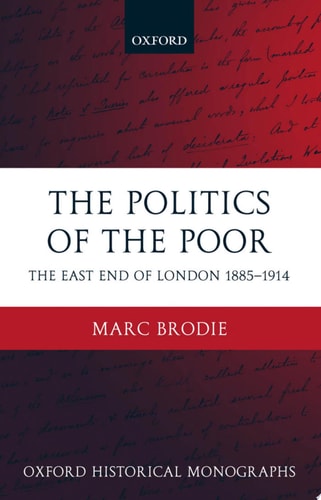
The Politics of the Poor: The East End of London 1885-1914
0
0
As an Amazon Associate and affiliate partner, Menrva Books earns from qualifying purchases. Learn more
Author Description
This book is about the political views of the 'classic' poor of London's East End in the late Victorian and Edwardian periods. The residents of this area have been historically characterized as abjectly poor, casually employed, slum dwellers with a poverty-induced apathy toward political solutions interspersed with occasional violent displays of support for populist calls for protectionism, imperialism, or anti-alien agitation. These factors, in combination, have been thought to have allowed the Conservative Party to politically dominate the East End in this period. This study demonstrates that many of these images are wrong. Economic conditions in the East End were not as uniformly bleak as often portrayed. The workings of the franchise laws also meant that those who possessed the vote in the East End were generally the most prosperous and regularly employed of their occupational group. Conservative electoral victories in the East End were not the result of poverty. Political attitudes in the East End were determined to a far greater extent by issues concerning the 'personal' in a number of senses. The importance given to individual character in the political judgements of the East End working class was greatly increased by a number specific local factors. These included the prevalence of particular forms of workplace structure, and the generally somewhat shorter length of time on the electoral register of voters in the area. Also important was a continuing attachment to the Church of England amongst a number of the more prosperous working class. In the place of many 'myths' about the people of the East End and their politics, this study provides a model that does not seek to explain the politics of the area in full, but suggests the point strongly that we can understand politics, and the formation of political attitudes, in the East End or any other area, only through a detailed examination of very specific localized community and workplace structures.
Menrva's Summary
THE THESIS
This book investigates the political motivations and electoral behaviors of London's East End working class between 1885 and 1914, challenging long-standing myths regarding their supposed apathy and populist leanings. Marc Brodie, a historian specializing in late Victorian and Edwardian social structures, utilizes archival electoral data and local economic records to dismantle the narrative that poverty drove the area's political outcomes. He argues that political attitudes were instead shaped by localized workplace structures, individual character assessments, and specific community affiliations rather than uniform economic desperation.
THE SCOPE MAP
What You Will Find
- Analysis of franchise laws and their impact on voter demographics in the East End.
- Examination of the relationship between workplace structure and political judgment.
- Assessment of the role of the Church of England in shaping the views of the prosperous working class.
- Evidence regarding the economic diversity of the East End population.
Scope Limits
- The study does not provide a comprehensive explanation of all political movements in the region.
- It focuses primarily on the period between 1885 and 1914, excluding broader national political shifts outside this timeframe.
THE AUTHORITY PERSPECTIVE
Scholars and historians frequently cite this work as a significant corrective to traditional interpretations of urban political history. Readers often note the academic density of the prose, which relies heavily on detailed archival analysis to support its revisionist claims.
Page Count:
256
Publication Date:
2004-01-01
Publisher:
Clarendon Press
ISBN-10:
0191556521
ISBN-13:
9780191556524
History
Social History
British History
London England
Political History
London History
Urban Studies
European History
Poor
Community Tags
Similar Books