Cities Divided: Politics and Religion in English Provincial Towns 1660-1722
0
0
As an Amazon Associate and affiliate partner, Menrva Books earns from qualifying purchases. Learn more
Author Description
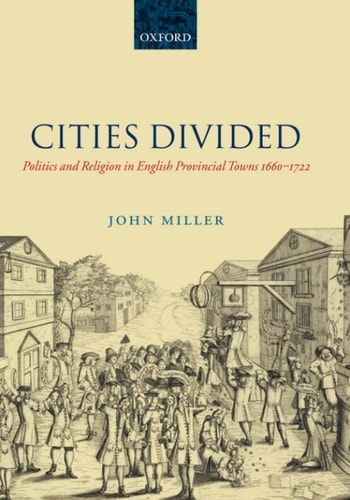
The religious and political history of late seventeenth- and early eighteenth-century England is typically written in terms of conflict and division. This was the period when party conflict - exacerbated by religious enmities - became a normal part of English life. Rather than denying the importance of partisan divisions, this book reveals how civic celebration, designed as an expression of unity and amity, was often used for partisan purposes, reaching a peak in the 1710s. The animosities were most marked in elections, which were often corrupt and drunken, and sometimes very violent. But division and conflict were not universal. Many towns avoided electoral contests, not because they were in the pocket of a great aristocrat, but as a matter of deliberate policy. Despite occasional disorder, urban government rarely broke down, and even violent elections ended with bruises rather than fatalities. Professor Miller suggests an explanation for this in the nature of urban governance. While the formal structures of town government were profoundly undemocratic - vacancies on corporations were most often filled by co-option - there was much participation, consultation, and negotiation in the lower levels of government. In addition, corporation members lived in close proximity to, and did business with, their fellow townspeople, and needed to meet their expectations. These expectations might have been modest - they wanted streets to be reasonably clean and kept in adequate repair, sewage and rubbish to be removed, law and order maintained, and the deserving poor relieved. But they were the things that made daily life tolerable, and for many they mattered more than politics.
Menrva's Summary
THE THESIS
This book investigates how the intersection of religious enmity and party politics shaped the governance and social stability of English provincial towns between 1660 and 1722. Professor John F. Miller utilizes extensive archival research into urban records and electoral history to argue that while partisan conflict was a defining feature of the era, it was tempered by the practical necessities of local governance and the daily expectations of townspeople. He posits that the informal, consultative nature of urban administration prevented systemic collapse despite the prevalence of corruption and occasional violence in electoral processes.
THE SCOPE MAP
What You Will Find
- Analysis of political and religious tensions in provincial England during the late seventeenth and early eighteenth centuries.
- Examination of urban governance structures, including the role of co-option and local consultation.
- Case studies of electoral practices, ranging from peaceful consensus to violent partisan contests.
- Assessment of municipal service delivery, such as sanitation and poor relief, as a stabilizing force.
Scope Limits
- The study focuses primarily on provincial towns rather than the political machinations of London or the national parliament.
- It does not provide a comprehensive biography of individual political figures, focusing instead on institutional and social trends.
THE AUTHORITY PERSPECTIVE
Historians recognize this work as a significant contribution to the study of early modern urban life, particularly for its nuanced view of how local politics functioned beneath the surface of national party strife. Scholars frequently cite the book for its balanced assessment of the limitations of democratic participation in the period.
Page Count:
344
Publication Date:
2007-01-01
Publisher:
Oxford University Press
ISBN-10:
0191537136
ISBN-13:
9780191537134
History
British History
Urban Studies
European History
Early Modern
Political History
Religious History
Community Tags
Similar Books