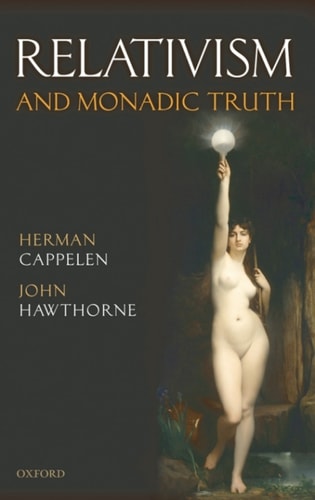
Relativism and Monadic Truth
0
0
As an Amazon Associate and affiliate partner, Menrva Books earns from qualifying purchases. Learn more
Author Description
Relativism has dominated many intellectual circles, past and present, but the twentieth century saw it banished to the fringes of mainstream analytic philosophy. Of late, however, it is making something of a comeback within that loosely configured tradition, a comeback that attempts to capitalize on some important ideas in foundational semantics. Relativism and Monadic Truth aims not merely to combat analytic relativism but also to combat the foundational ideas in semantics that led to its revival. Doing so requires a proper understanding of the significance of possible worlds semantics, an examination of the relation between truth and the flow of time, an account of putatively relevant data from attitude and speech act reporting, and a careful treatment of various operators. Throughout, Herman Cappelen and John Hawthorne contrast relativism with a view according to which the contents of thought and talk are propositions that instantiate the fundamental monadic properties of truth simpliciter and falsity simpliciter. Such propositions, they argue, are the semantic values of sentences (relative to context), the objects of illocutionary acts, and, unsurprisingly, the objects of propositional attitudes.
Menrva's Summary
THE THESIS
This book investigates the validity of contemporary analytic relativism by challenging the foundational semantic theories that support its recent resurgence. Herman Cappelen and John Hawthorne, both established figures in analytic philosophy, utilize a rigorous examination of possible worlds semantics and propositional logic to argue against relativistic frameworks. They propose an alternative model where the contents of thought and speech are propositions that possess monadic properties of truth and falsity, rather than being relative to context or perspective.
THE SCOPE MAP
What You Will Find
- Analysis of possible worlds semantics and their role in modern philosophical debates
- Examination of truth conditions in relation to temporal flow and speech act reporting
- A defense of monadic truth properties against relativistic interpretations
- Technical treatment of semantic operators and their impact on propositional content
Scope Limits
- The text does not provide an exhaustive history of relativism outside of the analytic tradition
- It does not address non-analytic or continental approaches to truth and subjectivity
THE AUTHORITY PERSPECTIVE
Experts recognize this work as a significant contribution to the ongoing debate within formal semantics and the philosophy of language. Readers frequently note the high level of academic density and the technical precision required to engage with the authors' arguments.
Page Count:
157
Publication Date:
2009-01-01
Publisher:
Oxford University Press
ISBN-10:
019156799X
ISBN-13:
9780191567995
Philosophy
Semantics
Logic
Metaphysics
Epistemology
Community Tags
Similar Books