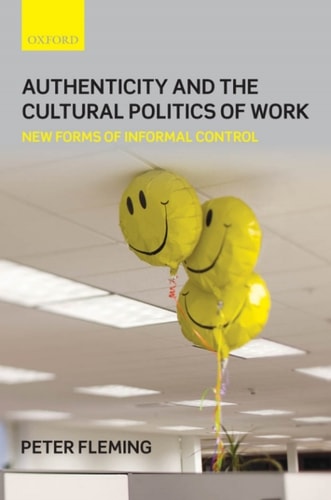
Authenticity and the Cultural Politics of Work: New Forms of Informal Control
0
0
As an Amazon Associate and affiliate partner, Menrva Books earns from qualifying purchases. Learn more
Author Description
The 'personal' was once something to be put to one side in the work place: a 'professional manner' entailed the suppression of private life and feelings. Now many large corporations can be found exhorting their employees to simply be themselves. This book critically investigates the increasing popularity of personal authenticity in corporate ideology and practice. Rather than have workers adhere to depersonalising bureaucratic rules or homogenous cultural norms, many large corporations now invite employees to simply be themselves. Alternative lifestyles, consumption, ethics, identity, sexuality, fun, and even dissent are now celebrated since employees are presumed to be more motivated if they can just be themselves. Does this freedom to express one's authenticity in the workplace finally herald the end of corporate control? To answer this question, the author places this concern with authenticity within a political framework and demonstrates how it might represent an even more insidious form of cultural domination. The book especially focuses on the way in which private and non-work selves are prospected and put to work in the firm. The ideas of Hardt and Negri and the Italian autonomist movement are used to show how common forms of association and co-operation outside of commodified work are the inspiration for personal authenticity. It is the vibrancy, energy and creativity of this non-commodified stratum of social life that managerialism now aims to exploit. Each chapter explores how this is achieved and highlights the worker resistance that is provoked as a result. The book concludes by demonstrating how the discourse of freedom underlying the managerial version of authenticity harbours potential for a radical transformation of the contemporary corporate form.
Menrva's Summary
THE THESIS
Does the corporate mandate for employees to 'be themselves' represent a genuine liberation of the individual or a sophisticated mechanism for deeper organizational control? Peter Fleming, a scholar in organizational studies, investigates the shift from traditional bureaucratic suppression to the modern corporate strategy of commodifying personal identity. By applying a political framework rooted in the work of Hardt and Negri, the author argues that managerialism now seeks to extract value from the private, non-work lives of employees, transforming personal authenticity into a tool for cultural domination.
THE SCOPE MAP
What You Will Find
- Analysis of the transition from professional detachment to the 'authentic' workplace.
- Application of Italian autonomist theory to contemporary corporate management.
- Examination of how private identity, sexuality, and dissent are integrated into firm productivity.
- Case studies on worker resistance to the encroachment of corporate culture into private life.
Scope Limits
- The text focuses primarily on large corporate environments rather than small-scale or non-profit organizational structures.
- It does not provide a comprehensive guide for human resource management, but rather a critical sociological critique of current trends.
THE AUTHORITY PERSPECTIVE
Scholars in the field of labor studies frequently cite this work as a critical contribution to understanding the 'affective' turn in management theory. Readers often note the academic density of the prose, which requires a foundational understanding of political philosophy to fully grasp the author's arguments.
Page Count:
224
Publication Date:
2009-01-01
Publisher:
OUP Oxford
ISBN-10:
0191569984
ISBN-13:
9780191569982
Principles of Management
Labor Studies
Psychology Industrial
Management
Sociology
Community Tags
Similar Books