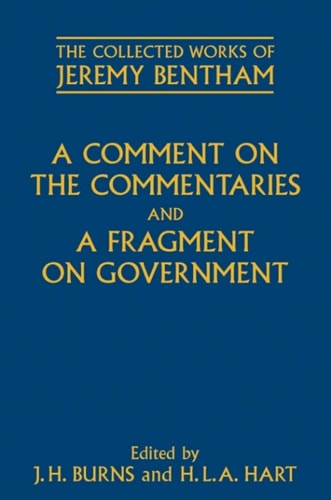
A Comment on the Commentaries and A Fragment on Government
0
0
As an Amazon Associate and affiliate partner, Menrva Books earns from qualifying purchases. Learn more
Author Description
In the two related works in this volume, Bentham offers a detailed critique of William Blackstone's Commentaries on the Laws of England (1765-9). In 'Comment on the Commentaries', on which Bentham began work in 1774, he exposes the fallacies which he claims to have detected in Blackstone, and criticizes the theory of the Common Law. He goes on to provide important reflections on the nature of law, and more particularly on the nature of customary and of statute law, and on judicial interpretation. A Fragment on Government, which was published in 1776, was detached from the 'Comment on the Commentaries'. Concentrating on a passage of five or six pages in which Blackstone discusses the origin of society and government, Bentham offers three main criticisms. First, he criticizes Blackstone's methodology for failing to distinguish between the role of the expositor and the role of the censor, and thereby confusing the question of what the law is with the question of what the law ought to be. Second, he criticizes Blackstone's assumption that the theory of the social contract represents an adequate justification of the obligation to obey government. Third, he criticizes Blackstone's theory of sovereignty, which claims that in every state there must exist some absolute, undivided power, whose commands are law. Bentham points to the existence of states where sovereign power is both divided and limited. In these two works, published by OUP for the first time, Bentham outlines a number of themes which he goes on to develop in his later works: the principle of utility; the importance of a 'natural arrangement' for a legal system; the point at which resistance to government becomes justifiable; the exposition of legal terms; and much more. The volume also contains Bentham's 'Preface' intended for, but not published in, the second edition of A Fragment on Government, which appeared in 1823. Having by this committed himself to political radicalism, Bentham uses this occasion to ref
Menrva's Summary
THE THESIS
This volume investigates the foundational flaws in 18th-century English legal theory by critiquing the prevailing interpretations of law and governance established by William Blackstone. Jeremy Bentham, a prominent legal philosopher, utilizes these texts to dismantle the conflation of descriptive and normative legal analysis. By challenging the social contract theory and the concept of absolute sovereignty, Bentham establishes the early framework for his utilitarian philosophy and the systematic reform of legal institutions.
THE SCOPE MAP
What You Will Find
- A comprehensive critique of Blackstone's Commentaries on the Laws of England.
- Analysis of the distinction between the expositor and the censor in legal study.
- Examination of the nature of customary versus statute law.
- Discussion on the limits of sovereign power and the justification of political resistance.
Scope Limits
- The text focuses primarily on the specific legal and political context of 18th-century Britain.
- It does not provide a modern application of these theories to contemporary international law.
THE AUTHORITY PERSPECTIVE
Scholars and legal historians view this collection as a foundational text for understanding the development of utilitarian legal thought. Readers frequently note the academic density of the prose, which requires a strong background in political philosophy to fully grasp the nuances of Bentham's arguments.
Page Count:
632
Publication Date:
2008-01-01
Publisher:
Clarendon Press
ISBN-10:
0191564788
ISBN-13:
9780191564789
Philosophy
History
European History
Law
History of Ideas
Legal Theory
Community Tags
Similar Books





Reader Comments
Share Your Thoughts
No comments yet. Be the first to share your thoughts!