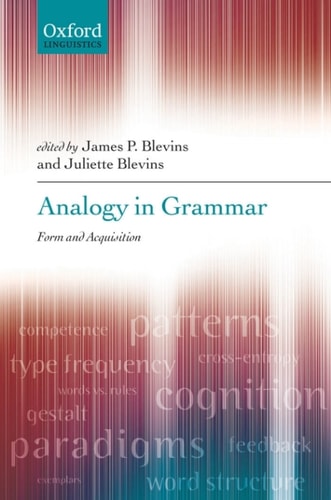
Analogy in Grammar: Form and Acquisition
0
0
As an Amazon Associate and affiliate partner, Menrva Books earns from qualifying purchases. Learn more
Author Description
In this book, leading researchers in morphology, syntax, language acquisition, psycholinguistics, and computational linguistics address central questions about the form and acquisition of analogy in grammar. What kinds of patterns do speakers select as the basis for analogical extension? What types of items are particularly susceptible or resistant to analogical pressures? At what levels do analogical processes operate and how do processes interact? What formal mechanisms are appropriate for modelling analogy? The novel synthesis of typological, theoretical, computational, and developmental paradigms in this volume brings us closer to answering these questions than ever before.
Menrva's Summary
THE THESIS
This volume investigates the formal mechanisms and cognitive processes that govern the role of analogy in the structure and acquisition of human language. Editors James P. Blevins and Juliette Blevins compile research from leading experts across multiple linguistic subfields to examine how speakers identify, select, and apply patterns during analogical extension. The work synthesizes typological, theoretical, and computational data to establish a framework for understanding why certain linguistic items remain resistant to change while others are susceptible to analogical pressure.
THE SCOPE MAP
What You Will Find
- Comparative analysis of morphological and syntactic patterns
- Computational models of analogical processes
- Developmental data regarding language acquisition in speakers
- Theoretical frameworks for formalizing analogical mechanisms
Scope Limits
- The text does not provide a comprehensive history of all linguistic theories of analogy
- It focuses primarily on formal and cognitive mechanisms rather than sociolinguistic variations
THE AUTHORITY PERSPECTIVE
Experts recognize this collection as a rigorous interdisciplinary resource for researchers in morphology and psycholinguistics. Readers frequently note the academic density of the prose, which is intended for advanced students and scholars in the field of linguistics.
Page Count:
400
Publication Date:
2009-01-01
Publisher:
OUP Oxford
ISBN-10:
0191569607
ISBN-13:
9780191569609
English & College Success
Computational linguistics
Syntax
Morphology
Linguistics
English
Psycholinguistics
Community Tags
Similar Books