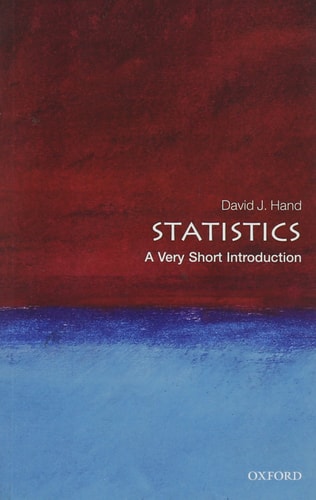
Statistics: A Very Short Introduction
0
0
As an Amazon Associate and affiliate partner, Menrva Books earns from qualifying purchases. Learn more
Author Description
Modern statistics is very different from the dry and dusty discipline of the popular imagination. In its place is an exciting subject which uses deep theory and powerful software tools to shed light and enable understanding. And it sheds this light on all aspects of our lives, enabling astronomers to explore the origins of the universe, archaeologists to investigate ancient civilisations, governments to understand how to benefit and improve society, and businesses to learn how best to provide goods and services. Aimed at readers with no prior mathematical knowledge, this Very Short Introduction explores and explains how statistics work, and how we can decipher them. ABOUT THE SERIES: The Very Short Introductions series from Oxford University Press contains hundreds of titles in almost every subject area. These pocket-sized books are the perfect way to get ahead in a new subject quickly. Our expert authors combine facts, analysis, perspective, new ideas, and enthusiasm to make interesting and challenging topics highly readable.
Menrva's Summary
THE THESIS
This book investigates the fundamental role of statistics in modern society, arguing that the discipline has evolved from a dry academic pursuit into a vital tool for understanding complex data across all fields of human endeavor. David J. Hand, a professor of statistics and senior research investigator at Imperial College London, draws upon his extensive background in data analysis and statistical theory to demystify the subject. He presents statistics not as a collection of static formulas, but as a dynamic framework for interpreting the world, aimed specifically at readers without a background in advanced mathematics.
THE SCOPE MAP
What You Will Find
- Explanations of core statistical concepts like probability, inference, and data modeling.
- Real-world applications ranging from astronomy and archaeology to government policy and business strategy.
- A conceptual overview of how software tools facilitate modern statistical analysis.
Scope Limits
- The text does not provide a comprehensive technical manual or a step-by-step guide for performing complex statistical calculations.
- It avoids deep-dive mathematical proofs in favor of conceptual clarity for the layperson.
THE AUTHORITY PERSPECTIVE
Experts and educators frequently cite this work as a highly accessible entry point for those seeking to understand the utility of statistics in everyday life. Readers often note that the prose is concise and effectively strips away the intimidation factor typically associated with quantitative analysis.
Page Count:
137
Publication Date:
2008-01-01
Publisher:
OUP Oxford
ISBN-10:
0191578924
ISBN-13:
9780191578922
Science
Mathematics Statistics
Mathematics
Education
Reference
Statistics
Mathematics - General
Probability