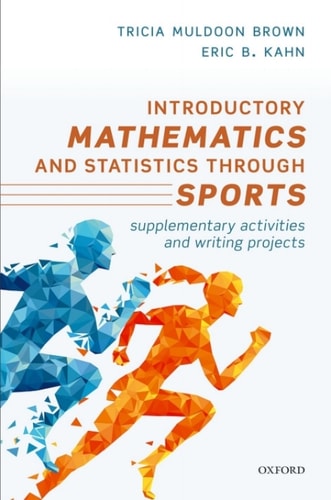
Introductory Mathematics and Statistics through Sports: Supplementary Activities and Writing Projects
0
0
As an Amazon Associate and affiliate partner, Menrva Books earns from qualifying purchases. Learn more
Author Description
Sport is a wildly popular and accessible pastime that most students find interest in. The link between mathematics and sports - particularly between statistics and sports - is well known, but is rarely used as a method for sparking a real interest and better understanding of mathematics at university level. Introductory Mathematics and Statistics through Sports develops this connection, and uses sport as a tool to help students get to grips with mathematics and statistics. It contains valuable resources, such as activities and writing projects for use in quantitative reasoning or introductory statistics classrooms. These inquiry-based activities and open-ended writing projects are all set in the authentic framework of a sporting environment and are designed to promote critical thinking and mathematical application skills that students can apply outside of the classroom. All activities and projects have been classroom-tested and are ready to be implemented as they are, or can be easily personalized by instructors with a helpful run-down of successes and misunderstandings for each project. Introductory Mathematics and Statistics through Sports places great emphasis on the communication, application, and internalization of mathematics for students whose primary interests are not necessarily in STEM fields.
Menrva's Summary
THE THESIS
This book investigates how sports-based inquiry can serve as a pedagogical bridge to improve student engagement and comprehension in university-level mathematics and statistics. Authors Eric B. Kahn and Tricia Muldoon Brown utilize their experience in classroom instruction to present a collection of activities designed to demystify quantitative concepts. The framework emphasizes the application of mathematical modeling and statistical analysis within the context of athletic performance, aiming to increase accessibility for non-STEM majors.
THE SCOPE MAP
What You Will Find
- A collection of classroom-tested inquiry-based activities
- Open-ended writing projects focused on quantitative reasoning
- Instructor guides detailing common student misunderstandings and successful implementation strategies
Scope Limits
- The text does not provide a comprehensive theoretical textbook on advanced statistical theory
- It does not cover specialized software programming or high-level computational coding
THE AUTHORITY PERSPECTIVE
Educators frequently cite this work as a practical resource for instructors seeking to increase student participation in introductory quantitative courses. The consensus among academic reviewers is that the book successfully translates abstract mathematical concepts into concrete, relatable scenarios for students outside of technical disciplines.
Page Count:
144
Publication Date:
2019-01-01
Publisher:
OUP Oxford
ISBN-10:
0192572660
ISBN-13:
9780192572660
Mathematics Statistics
Sports Science
Education
Mathematics
Statistics
Pedagogy
Probability
Community Tags
Similar Books