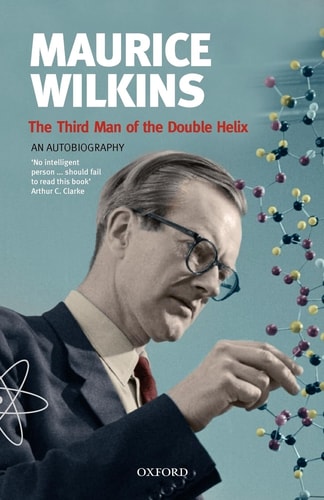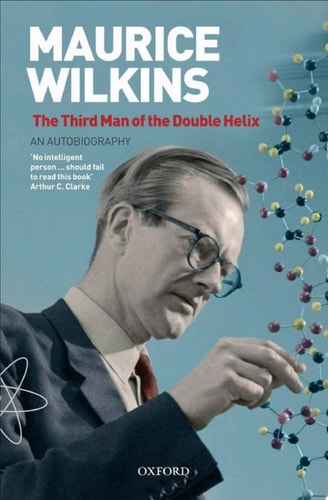
Maurice Wilkins: The Third Man of the Double Helix: An Autobiography
0
0
As an Amazon Associate and affiliate partner, Menrva Books earns from qualifying purchases. Learn more
Author Description
Francis Crick and Jim Watson are well known for their discovery of the structure of DNA in Cambridge in 1953. But they shared the Nobel Prize for the discovery of the Double Helix with a third man, Maurice Wilkins, a diffident physicist who did not enjoy the limelight. He and his team at King's College London had painstakingly measured the angles, bonds, and orientations of the DNA structure - data that inspired Crick and Watson's celebrated model - and they then spent many years demonstrating that Crick and Watson were right before the Prize was awarded in 1962. Wilkins's career had already embraced another momentous and highly controversial scientific achievement - he had worked during World War II on the atomic bomb project - and he was to face a new controversy in the 1970s when his co-worker at King's, the late Rosalind Franklin, was proclaimed the unsung heroine of the DNA story, and he was accused of exploiting her work. Now aged 86, Maurice Wilkins marks the fiftieth anniversary of the discovery of the Double Helix by telling, for the first time, his own story of the discovery of the DNA structure and his relationship with Rosalind Franklin. He also describes a life and career spanning many continents, from his idyllic early childhood in New Zealand via the Birmingham suburbs to Cambridge, Berkeley, and London, and recalls his encounters with distinguished scientists including Arthur Eddington, Niels Bohr, and J. D. Bernal. He also reflects on the role of scientists in a world still coping with the Bomb and facing the implications of the gene revolution, and considers, in this intimate history, the successes, problems, and politics of nearly a century of science.
Menrva's Summary
THE THESIS
How did the collaborative, often contentious, efforts of physicists and biologists lead to the identification of the DNA double helix structure? Maurice Wilkins, a Nobel laureate and physicist, provides a firsthand account of his contributions to molecular biology and his involvement in the Manhattan Project. He utilizes his personal archives and professional recollections to contextualize the competitive environment of 1950s research, specifically addressing the complex dynamics between his team at King's College London and the Cambridge group of Watson and Crick.
THE SCOPE MAP
What You Will Find
- Detailed accounts of the experimental X-ray diffraction work on DNA structure.
- Personal reflections on the ethical implications of the atomic bomb project.
- Firsthand perspectives on the professional relationship with Rosalind Franklin.
- Historical context regarding the scientific community in the mid-20th century.
Scope Limits
- The text does not provide a comprehensive technical manual for modern genetic sequencing.
- It does not serve as an exhaustive biography of all colleagues mentioned, focusing primarily on Wilkins's own experiences.
THE AUTHORITY PERSPECTIVE
Experts and historians of science view this work as a critical primary source for understanding the human elements behind the discovery of the double helix. Readers frequently note the candid, reflective tone Wilkins employs when addressing the controversies surrounding his career and his interactions with Rosalind Franklin.
Page Count:
289
Publication Date:
2005-01-01
Publisher:
OUP Oxford
ISBN-10:
0191578142
ISBN-13:
9780191578144
Science
Biography
Autobiography
English
Science History
Biography Autobiography
Physics
Genetics
English & College Success
Community Tags
Similar Books