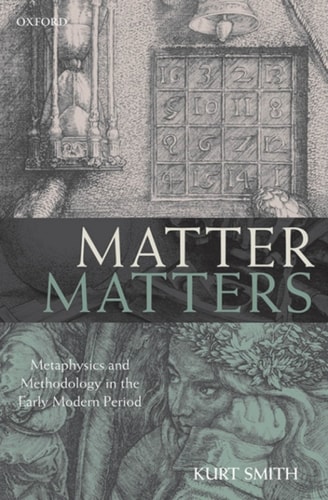
Matter Matters: Metaphysics and Methodology in the Early Modern Period
0
0
As an Amazon Associate and affiliate partner, Menrva Books earns from qualifying purchases. Learn more
Author Description
Why is there a material world? Why is it fundamentally mathematical? Matter Matters explores a seventeenth-century answer to these questions as it emerged from the works of Descartes and Leibniz. The 'mathematization' of the physics is shown to have been conceptually underwritten by two methods of philosophizing, namely, analysis and synthesis. The connection between these things--mathematics, matter, and the methods of analysis and synthesis--has thus far gone unexplored by scholars. The book is in four Parts: Part I works out the context in which the theory of modern matter arose. Part II develops the method of analysis, showing how it aligns with Descartes's famous doctrine of clear and distinct ideas. Part III develops the method of synthesis, focusing primarily on Leibniz, showing how it establishes the very conditions necessary and sufficient for mathematics. Analysis and synthesis turn out to establish isomorphic conceptual systems, which turn out to be isomorphic to what mathematicians today call a group. The group concept expresses the conditions underwriting all of mathematics. Part IV examines several relatively new interpretations of Descartes--the realist and idealist readings--which appear to be at odds with one another. The examination shows the sense in which these readings are actually compatible, and together reveal a richer picture of Descartes's position on the reality of matter. Ultimately, Matter Matters establishes the claim that mathematics is intelligible if, and only if, matter exists.
Menrva's Summary
THE THESIS
This book investigates the ontological and methodological foundations of the material world by examining the seventeenth-century philosophical frameworks of Descartes and Leibniz. Kurt Smith, a scholar of early modern philosophy, utilizes historical texts and mathematical logic to argue that the mathematization of physics during this period was fundamentally supported by the methods of analysis and synthesis. The work posits that mathematics remains intelligible only through the existence of matter, establishing a necessary link between these conceptual domains.
THE SCOPE MAP
What You Will Find
- A detailed analysis of Cartesian and Leibnizian philosophical doctrines.
- An exploration of the methods of analysis and synthesis as isomorphic conceptual systems.
- A comparison of realist and idealist interpretations of Descartes's work.
- An application of modern group theory to historical philosophical conditions.
Scope Limits
- The text does not provide a comprehensive history of all seventeenth-century natural philosophy.
- It does not address post-Leibnizian developments in the philosophy of mathematics.
THE AUTHORITY PERSPECTIVE
Scholars and students of early modern philosophy frequently note the technical density of the prose and the rigorous application of mathematical concepts to historical texts. Experts highlight this as a specialized contribution to the study of Cartesian and Leibnizian metaphysics, particularly regarding the intersection of methodology and ontology.
Page Count:
304
Publication Date:
2010-01-01
Publisher:
Oxford University Press
ISBN-10:
0191576913
ISBN-13:
9780191576911
Philosophy
Epistemology
Metaphysics
Mathematics
Early Modern
Philosophy history
Matter
Community Tags
Similar Books