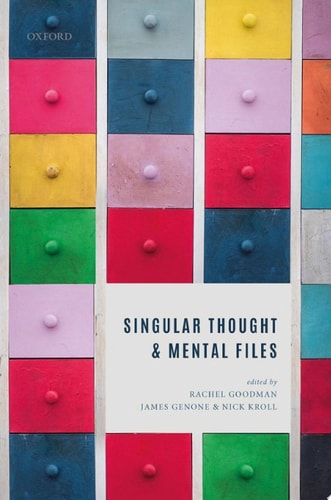
Singular Thought and Mental Files
0
0
As an Amazon Associate and affiliate partner, Menrva Books earns from qualifying purchases. Learn more
Author Description
The notion of singular (or de re) thought has become central in philosophy of mind and language, yet there is still little consensus concerning the best way to think about the nature of singular thought. Coinciding with recognition of the need for more clarity about the notion, there has been a surge of interest in the concept of a mental file as a way to understand what is distinctive about singular thought. What isn't always clear, however, is what mental files are meant to be, and why we should believe that thoughts that employ them are singular as opposed to descriptive. This volume brings together original chapters by leading scholars which aim to examine and evaluate the viability of the mental files framework for theorizing about singular thought. The first section of the volume addresses the central issues of the definition and nature of singular thought, as well as how it relates to the notion of a mental file. The second section addresses the legitimacy of the mental files conception of singular thought by assessing the philosophical motivations or the purported empirical support for the view, or by laying out a specific version of it. The third section helps to clarify both the notion of a mental file and the mental files conception of singular thought by focusing on their role in explaining de jure coreference in thought and language. The volume then concludes with a final section that casts doubt on the mental files conception and the legitimacy of the file-theoretic framework more generally.
Menrva's Summary
THE THESIS
This volume investigates whether the mental files framework provides a viable and accurate account of singular (de re) thought. The editors, James Genone, Nick Kroll, and Rachel Goodman, curate a collection of original essays from leading scholars to address the ambiguity surrounding the nature of mental files and their role in distinguishing singular from descriptive thought. The contributors evaluate the theoretical foundations, empirical support, and logical implications of using mental files to explain cognitive processes.
THE SCOPE MAP
What You Will Find
- Theoretical definitions of singular thought and its relationship to mental files
- Philosophical arguments regarding de jure coreference in language and cognition
- Critical assessments of the file-theoretic framework
- Empirical and conceptual motivations for adopting the mental files model
Scope Limits
- Does not provide a unified or singular theory of mind
- Does not cover non-linguistic or non-propositional forms of cognition in depth
THE AUTHORITY PERSPECTIVE
Experts identify this collection as a significant contribution to contemporary debates in the philosophy of mind and language. Readers frequently note the academic density of the prose, making it a resource primarily intended for graduate-level researchers and professional philosophers.
Page Count:
278
Publication Date:
2020-01-01
Publisher:
OUP Oxford
ISBN-10:
0191063878
ISBN-13:
9780191063879
Philosophy
Mind & Body
Epistemology
Thought And Thinking
Philosophy of
Community Tags
Other Editions(3)


Similar Books








Reader Comments
Share Your Thoughts
No comments yet. Be the first to share your thoughts!