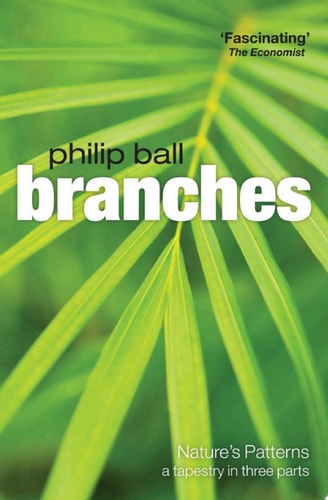
Branches: Nature's Patterns: A Tapestry in Three Parts
0
0
As an Amazon Associate and affiliate partner, Menrva Books earns from qualifying purchases. Learn more
Author Description
As part of a trilogy of books exploring the science of patterns in nature, acclaimed science writer Philip Ball here looks at the form and growth of branching networks in the natural world, and what we can learn from them. Many patterns in nature show a branching form - trees, river deltas, blood vessels, lightning, the cracks that form in the glazing of pots. These networks share a peculiar geometry, finding a compromise between disorder and determinism, though some, like the hexagonal snowflake or the stones of the Devil's Causeway fall into a rigidly ordered structure. Branching networks are found at every level in biology - from the single cell to the ecosystem. Human-made networks too can come to share the same features, and if they don't, then it might be profitable to make them do so: nature's patterns tend to arise from economical solutions.
Menrva's Summary
THE THESIS
This book investigates the underlying geometric and physical principles that govern the formation of branching networks across diverse natural and human-made systems. Philip Ball, a science writer with extensive experience in physical sciences, utilizes principles from fluid dynamics, biology, and mathematics to argue that branching patterns represent economical solutions to the problem of transport and distribution. By examining these structures, he demonstrates how nature balances deterministic growth with chaotic environmental variables to achieve efficiency.
THE SCOPE MAP
What You Will Find
- Analysis of branching structures in biological systems like blood vessels and tree growth.
- Examination of physical phenomena including river deltas, lightning, and ceramic glazing cracks.
- Discussion of the intersection between natural geometry and human-engineered network design.
Scope Limits
- The text does not provide a comprehensive mathematical proof for every branching phenomenon discussed.
- It does not cover non-branching patterns in depth, as those are reserved for other volumes in the trilogy.
THE AUTHORITY PERSPECTIVE
Experts and readers alike recognize this work as an accessible entry point into the study of morphogenesis and pattern formation. The prose is noted for its clarity, successfully bridging the gap between complex physical theory and observable natural phenomena.
Page Count:
227
Publication Date:
2009-01-01
Publisher:
OUP Oxford
ISBN-10:
0191579831
ISBN-13:
9780191579837
Nature
Science
Patterns
Biology
Physics
Chaotic behavior in systems
Earth Sciences
Mathematics
Community Tags
Similar Books