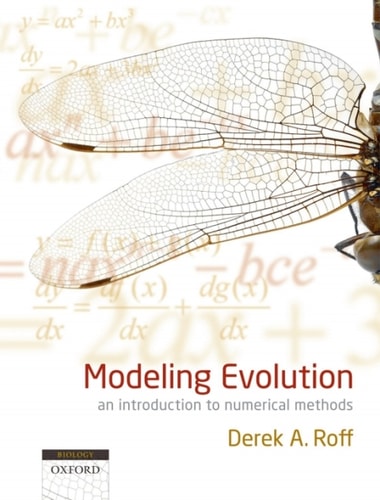
Modeling Evolution: An Introduction to Numerical Methods
0
0
As an Amazon Associate and affiliate partner, Menrva Books earns from qualifying purchases. Learn more
Author Description
Computer modeling is now an integral part of research in evolutionary biology. The advent of increased processing power in the personal computer, coupled with the availability of languages such as R, SPLUS, Mathematica, Maple, Mathcad, and MATLAB, has ensured that the development and analysis of computer models of evolution is now within the capabilities of most graduate students. However, there are two hurdles that tend to discourage students from making full use of the power of computer modeling. The first is the general problem of formulating the question and the second is its implementation using an appropriate computer language. Modeling Evolution outlines how evolutionary questions are formulated and how, in practice, they can be resolved by analytical and numerical methods (with the emphasis being on the latter). Following a general introduction to computer modeling, successive chapters describe "Fisherian" optimality models, invasibility analysis, genetic models, game theoretic models, and dynamic programming. A common chapter plan facilitates tuition and comprises an introduction (in which the general approach and methods are described) followed by a series of carefully structured scenarios that have been selected to highlight particular aspects of evolutionary modeling. Coding for each example is provided in either R or MATLAB since both of these programs are readily available and extensively used. This coding is available on the author's web site allowing easy implementation and study of the programs. Each chapter concludes with a list of exemplary papers which have been chosen on the basis of how well they explain and illustrate the techniques discussed in the chapter.
Menrva's Summary
THE THESIS
How can graduate students effectively bridge the gap between formulating evolutionary research questions and implementing them through computational modeling? Derek A. Roff, a specialist in evolutionary biology, provides a structured framework for translating biological theory into numerical simulations. By focusing on practical implementation, the text addresses the technical barriers that often prevent researchers from utilizing modern computational tools in evolutionary studies.
THE SCOPE MAP
What You Will Find
- Methodologies for Fisherian optimality, invasibility analysis, and genetic modeling
- Applications of game theoretic models and dynamic programming
- Practical coding examples implemented in R and MATLAB
- Curated lists of foundational papers for further study
Scope Limits
- The text does not provide a comprehensive manual for general programming syntax
- It does not cover advanced high-performance computing or parallel processing architectures
THE AUTHORITY PERSPECTIVE
Experts recognize this text as a practical resource for students transitioning from theoretical biology to computational research. Readers frequently note the clarity of the structured scenarios, which facilitate a direct application of numerical methods to evolutionary problems.
Page Count:
352
Publication Date:
2009-01-01
Publisher:
OUP Oxford
ISBN-10:
0191576689
ISBN-13:
9780191576683
Science
Evolution
Evolutionary Biology
Academic
Mathematics
Computer Modeling
Numerical Methods
Community Tags
Similar Books