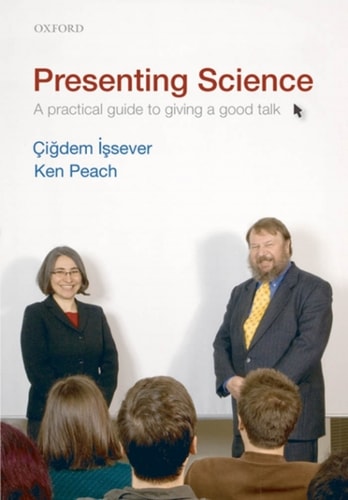
Presenting Science: A Practical Guide to Giving a Good Talk
0
0
As an Amazon Associate and affiliate partner, Menrva Books earns from qualifying purchases. Learn more
Author Description
'Giving a talk' is one of the most important ways in which we communicate our research. The 'talk' covers everything from a ten-minute briefing on progress to a handful of colleagues, to a keynote address to a major international conference with more than a thousand delegates. Whatever the occasion, the aim is the same - to get the message across clearly and effectively. At the same time, presentational skills are becoming more important in all walks of life - and presenting science has particular issues. Our aim is to equip the reader with the basic skills needed to make a good presentation, and our approach is pragmatic, not dogmatic. We emphasise four points: - The goal is to communicate the science to the audience. - The speaker is responsible for everything that appears, and does not appear, on each slide. - The structure and appearance of the presentation are part of the communication process. - There is no standard way of doing things. Giving a good talk on science is a skill that can be learnt like any other: in this book we take the reader through the process of presenting science to a wide variety of audiences.
Menrva's Summary
THE THESIS
This book investigates the core question of how scientists can effectively communicate complex research through oral presentations. The authors, Cigdem Issever and Ken Peach, draw upon their extensive experience in the scientific community to provide a pragmatic framework for public speaking. They argue that presentation skills are a learnable craft, emphasizing that the speaker bears full responsibility for the clarity and structure of their message regardless of the audience size or setting.
THE SCOPE MAP
What You Will Find
- Strategies for tailoring scientific content to diverse audience levels
- Best practices for slide design and visual communication
- Techniques for managing nerves and engaging listeners during a talk
- Guidelines for structuring presentations from short briefings to keynote addresses
Scope Limits
- Does not cover written communication or academic publishing
- Does not provide advanced graphic design tutorials for specialized software
THE AUTHORITY PERSPECTIVE
Experts and academics frequently cite this work as a practical, no-nonsense resource for researchers at all career stages. Readers often note the accessible, non-dogmatic tone that makes the technical advice easy to implement in real-world settings.
Page Count:
136
Publication Date:
2009-01-01
Publisher:
OUP Oxford
ISBN-10:
0191574236
ISBN-13:
9780191574238
Science
Academic writing
Earth Sciences
Public Speaking
Education
Professional Development
Communication
Community Tags
Similar Books