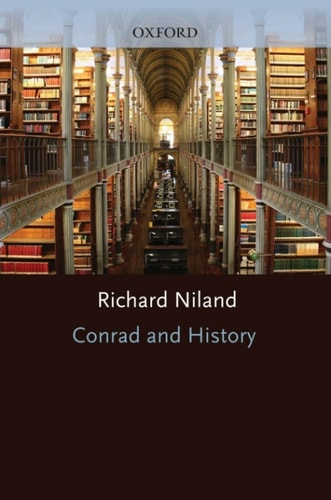
Conrad and History
0
0
As an Amazon Associate and affiliate partner, Menrva Books earns from qualifying purchases. Learn more
Author Description
This book examines the philosophy of history and the subject of the nation in the literature of Joseph Conrad. It explores the importance of nineteenth-century Polish Romantic philosophy in Conrad's literary development, arguing that the Polish response to Hegelian traditions of historiography in nineteenth-century Europe influenced Conrad's interpretation of history. After investigating Conrad's early career in the context of the philosophy of history, the book analyses Nostromo (1904), The Secret Agent (1907), and Under Western Eyes (1911) in light of Conrad's writing about Poland and his sustained interest in the subject of national identity. Conrad juxtaposes his belief in an inherited Polish national identity, derived from Herder and Rousseau, with a sceptical questioning of modern nationalism in European and Latin American contexts. Nostromo presents the creation of the modern nation state of Sulaco; The Secret Agent explores the subject of 'foreigners' and nationality in England; while Under Western Eyes constitutes a systematic attempt to undermine Russian national identity. Conrad emerges as an author who examines critically the forces of nationalism and national identity that troubled Europe throughout the nineteenth century and in the period before the First World War. This leads to a consideration of Conrad's work during the Great War. In his fiction and newspaper articles during the war, Conrad found a way of dealing with a conflict that made him acutely aware of being sidelined at a turning point in both modern Polish and modern European history. Finally, this book re-evaluates Conrad's late novels The Rover (1923) and Suspense (1925), a long-neglected part of his career, investigating Conrad's sustained treatment of French history in his last years alongside his life-long fascination with the cult of Napoleon Bonaparte.
Menrva's Summary
THE THESIS
This book investigates how Joseph Conrad’s engagement with nineteenth-century Polish Romantic philosophy and Hegelian historiography shaped his critical perspective on nationalism and national identity. Richard Niland, an academic scholar, utilizes a synthesis of historical context and textual analysis to argue that Conrad’s literary output was deeply informed by his Polish heritage. By examining the tension between inherited national identity and modern statehood, the author provides a framework for understanding Conrad’s skepticism toward European and Latin American political structures.
THE SCOPE MAP
What You Will Find
- Analysis of Conrad’s major novels including Nostromo, The Secret Agent, and Under Western Eyes.
- Examination of the influence of Herder, Rousseau, and Polish Romanticism on Conrad’s worldview.
- Investigation into Conrad’s late-career focus on French history and the legacy of Napoleon Bonaparte.
Scope Limits
- The text does not provide a comprehensive biography of Conrad’s entire life, focusing instead on his intellectual and historical development.
- It does not offer a general literary survey of all Conrad’s works, prioritizing those most relevant to the philosophy of history.
THE AUTHORITY PERSPECTIVE
Scholars and critics recognize this work as a significant contribution to Conradian studies, particularly for its focus on the often-overlooked late novels. Readers frequently note the academic density of the prose, which is tailored for researchers and students of literary history.
Page Count:
228
Publication Date:
2010-01-01
Publisher:
Oxford University Press
ISBN-10:
0191573809
ISBN-13:
9780191573804
Philosophy
Biography
History
English
English & College Success
European
In literature
Literary Criticism
Academic