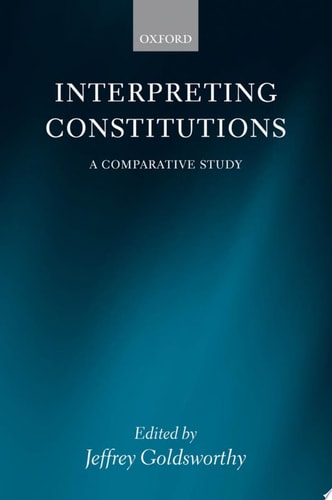
Interpreting Constitutions
0
0
As an Amazon Associate and affiliate partner, Menrva Books earns from qualifying purchases. Learn more
Author Description
This Book Describes The Constitutions Of Six Major Federations And How They Have Been Interpreted By Their Highest Courts, Compares The Interpretive Methods And Underlying Principles That Have Guided The Courts, And Explores The Reasons For Major Differences Between These Methods And Principles. Among The Interpretive Methods Discussed Are Textualism, Purposivism, Structuralism And Originalism. Each Of The Six Federations Is The Subject Of A Separate Chapter Written By A Leading Authority In The Field: Jeffrey Goldsworthy (australia), Peter Hogg (canada), Donald Kommers (germany), S.p. Sathe (india), Heinz Klug (south Africa), And Mark Tushnet (united States). Each Chapter Describes Not Only The Interpretive Methodology Currently Used By The Courts, But The Evolution Of That Methodology Since The Constitution Was First Enacted. The Book Also Includes A Concluding Chapter Which Compares These Methodologies, And Attempts To Explain Variations By Reference To Different Social, Historical, Institutional And Political Circumstances.
Menrva's Summary
THE THESIS
This work investigates the diverse interpretive methodologies employed by high courts across six major federations to determine how constitutional meaning is constructed and evolved. Edited by Jeffrey Goldsworthy, the book compiles contributions from leading legal scholars who analyze the historical and political contexts shaping judicial interpretation. The text provides a comparative framework to understand why different nations adopt specific approaches such as textualism, purposivism, or originalism.
THE SCOPE MAP
What You Will Find
- Comparative analysis of constitutional interpretation in Australia, Canada, Germany, India, South Africa, and the United States.
- Examination of interpretive methodologies including textualism, purposivism, structuralism, and originalism.
- Historical evolution of judicial methodologies from the enactment of each constitution to the present day.
Scope Limits
- The analysis is restricted to the six specific federations mentioned and does not provide a global survey of all constitutional systems.
- The text focuses primarily on high court jurisprudence rather than lower court applications or legislative drafting processes.
THE AUTHORITY PERSPECTIVE
Legal scholars and practitioners recognize this volume as a significant comparative resource for understanding the divergence in judicial philosophies across democratic systems. Readers frequently note the academic density of the prose, which serves as a rigorous reference for students and professionals in constitutional law.
Page Count:
384
Publication Date:
2006-01-01
Publisher:
Oup Oxford
ISBN-10:
0191582441
ISBN-13:
9780191582448
Law
Constitutional Law
Government
Comparative Law
Community Tags
Similar Books