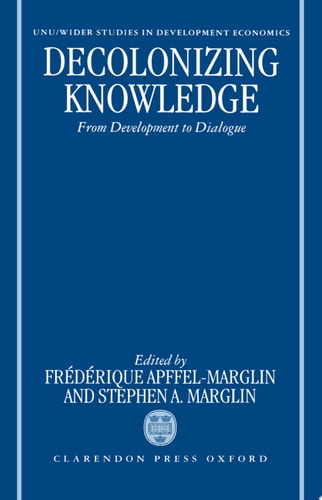
Decolonizing Knowledge
0
0
As an Amazon Associate and affiliate partner, Menrva Books earns from qualifying purchases. Learn more
Author Description
Development Failures, Environmental Degradation And Social Fragmentation Can No Longer Be Regarded As Side Effects Of `externalities'. They Are The Toxic Consequences Of Pretensions That The Modern Western View Of Knowledge Is A Universal Neutral View, Applicable To All People At All Times. The Very Word `development' And Its Cognates `underdevelopment' And `developing' Confidently Mark The `first' World's As The Future Of The `third'. This Book Argues That The Linear Evolutionary Paradigm Of Development That Comes Out Of Modern Western View Of Knowledge Is A Contemporary Form Of Colonialism. The Authors - Covering Topics As Diverse As The Theory Of Knowledge Underlying The Work Of John Maynard Keynes, What The Renowned British Geneticist J.b.s. Haldane Was Looking For When He Migrated To India, The Knowledge Of Mexican And Indian Peasants - Propose A Pluralistic Vision And Decolonization Of Knowledge: The Replacement Of One-way Transfers Of Knowledge And Technology By Dialogue And Mutual Learning.
Menrva's Summary
THE THESIS
This work investigates whether the modern Western paradigm of knowledge functions as a form of contemporary colonialism that necessitates a shift toward a pluralistic, dialogical framework. The authors, Frédérique Apffel-Marglin and Stephen A. Marglin, utilize their backgrounds in anthropology and economics to challenge the assumption that Western knowledge is universal and neutral. They argue that the linear evolutionary model of development imposes destructive social and environmental consequences on non-Western societies, advocating instead for a model based on mutual learning and the recognition of diverse knowledge systems.
THE SCOPE MAP
What You Will Find
- Analysis of the epistemological foundations of modern economic theory, specifically the work of John Maynard Keynes.
- Historical case studies regarding the migration of Western scientists like J.B.S. Haldane to India.
- Comparative examinations of traditional knowledge systems held by Mexican and Indian peasant populations.
- A theoretical framework for replacing unidirectional technology transfers with cross-cultural dialogue.
Scope Limits
- The text does not provide a comprehensive policy manual for implementing these changes in global institutions.
- It does not offer a detailed critique of every specific development agency currently in operation.
THE AUTHORITY PERSPECTIVE
Scholars in postcolonial and development studies frequently cite this text as a foundational critique of Western-centric development models. Readers often note the academic density of the prose, which requires a strong background in social theory to fully grasp the authors' arguments.
Page Count:
410
Publication Date:
1996-01-01
Publisher:
Clarendon Press
ISBN-10:
0191583960
ISBN-13:
9780191583964
Economics
Philosophy of
Sociology
Community Tags
Similar Books