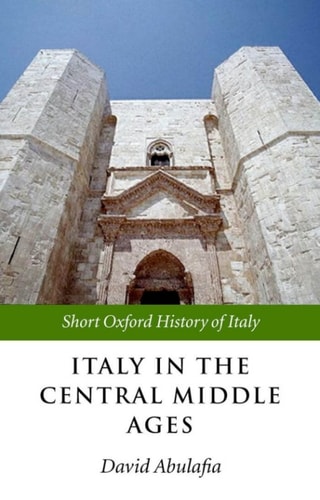
Italy in the Central Middle Ages: 1000-1300
0
0
As an Amazon Associate and affiliate partner, Menrva Books earns from qualifying purchases. Learn more
Author Description
The eleventh to the early fourteenth centuries saw a great transformation in the political, cultural and economic life of the Italian peninsula, marked by the rise of the autonomous city-states in the north and centre, the expansion of international trade, and the creation of a wealthy southern kingdom which reached the peak of its power in this period, before fragmenting in two in the late thirteenth century. It was also the period in which the various dialects that we now call the Italian language came into being, and in which Tuscan in particular became the vehicle for impressive literary innovation. Presenting a rounded view of Italy at a time when it was the most dynamic region in western Europe, this book looks at Italy in its entirety, rather than concentrating largely on the north, as previous studies have done. It also includes expert coverage of topics such as the family and the Jewish, Greek, and Muslim minority communities, in addition to its coverage of developments in the cities, rural life, trade, the monarchy, papal Italy, and language and culture.
Menrva's Summary
THE THESIS
This work investigates the political, economic, and cultural transformation of the Italian peninsula between the eleventh and early fourteenth centuries. David Abulafia, a distinguished historian of the Mediterranean, utilizes a comprehensive synthesis of regional developments to argue that Italy functioned as the most dynamic region in western Europe during this era. By moving beyond the traditional focus on northern city-states, the author provides a holistic analysis of the peninsula, including the southern kingdom and the diverse social structures that defined the period.
THE SCOPE MAP
What You Will Find
- Analysis of the rise of autonomous city-states and the expansion of international trade.
- Examination of the southern kingdom's political trajectory and eventual fragmentation.
- Discussion of linguistic evolution, specifically the emergence of Tuscan as a literary medium.
- Coverage of social history, including family structures and minority communities such as Jewish, Greek, and Muslim populations.
Scope Limits
- The study is strictly confined to the chronological period of 1000 to 1300.
- It does not provide an exhaustive military history of the Italian wars.
THE AUTHORITY PERSPECTIVE
Scholars and students frequently cite this work as a foundational text for understanding the complexity of medieval Italy beyond the standard northern-centric narrative. The prose is noted for its academic rigor and its ability to synthesize disparate regional histories into a coherent overview.
Page Count:
320
Publication Date:
2004-05-06
Publisher:
Oxford University Press
ISBN-10:
0191588822
ISBN-13:
9780191588822
History
European History
Italy
Italy history
Academic
Community Tags
Similar Books