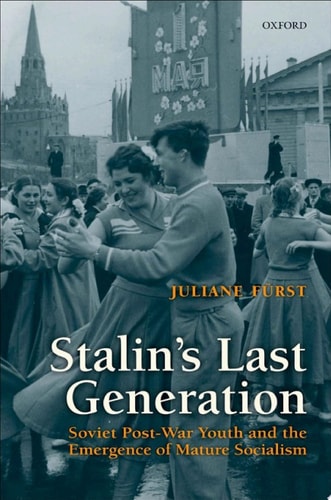
Stalin's Last Generation: Soviet Post-War Youth and the Emergence of Mature Socialism
0
0
As an Amazon Associate and affiliate partner, Menrva Books earns from qualifying purchases. Learn more
Author Description
'Stalin's last generation' was the last generation to come of age under Stalin, yet it was also the first generation to be socialized in the post-war period. Its young members grew up in a world that still carried many of the hallmarks of the Soviet Union's revolutionary period, yet their surroundings already showed the first signs of decay, stagnation, and disintegration. Stalin's last generation still knew how to speak 'Bolshevik', still believed in the power of Soviet heroes and still wished to construct socialism, yet they also liked to dance and dress in Western styles, they knew how to evade boring lectures and lessons in Marxism-Leninism, and they were keen to forge identities that were more individual than those offered by the state. In this book, Juliane Fürst creates a detailed picture of late Stalinist youth and youth culture, looking at young people from a variety of perspectives: as children of the war, as recipients and creators of propaganda, as perpetrators of crime, as representatives of fledgling subcultures, as believers, as critics, and as drop-outs. In the process, she illuminates not only the complex relationship between the Soviet state and its youth, but also provides a new interpretative framework for understanding late Stalinism - the impact of which on Soviet society's subsequent development has hitherto been underestimated, including its role in the ultimate demise of the USSR.
Menrva's Summary
THE THESIS
This book investigates how the generation coming of age in the final years of Stalin's rule navigated the tension between state-mandated socialist identity and the emerging realities of post-war Soviet life. Historian Juliane Fürst utilizes archival research and social analysis to examine the dual existence of these young people, who were simultaneously products of revolutionary propaganda and early adopters of individualistic, Western-influenced cultural practices. The work argues that this specific cohort played a critical, previously overlooked role in the long-term trajectory of the Soviet Union, including its eventual collapse.
THE SCOPE MAP
What You Will Find
- Analysis of late Stalinist youth culture and subcultures
- Examination of the interplay between state propaganda and individual identity
- Case studies covering diverse youth experiences, including believers, critics, and drop-outs
Scope Limits
- The study focuses primarily on the late Stalinist period and does not provide an exhaustive history of the entire Soviet era
- The analysis is centered on social and cultural dynamics rather than high-level political or military strategy
THE AUTHORITY PERSPECTIVE
Scholars and historians recognize this work as a significant contribution to the study of Soviet social history, particularly for its nuanced look at the internal contradictions of the late Stalinist state. Readers frequently note the academic density of the prose, which provides a rigorous and well-documented examination of a pivotal, yet often misunderstood, generation.
Page Count:
408
Publication Date:
2010-09-01
Publisher:
OUP Oxford
ISBN-10:
0191591467
ISBN-13:
9780191591464
History
Europe
Soviet History
Youth Culture
Social History
20th Century
Social Science