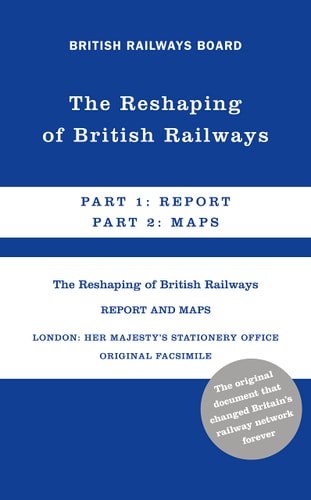
The Reshaping of British Railways Part 1: Report and Part 2: Maps
0
0
As an Amazon Associate and affiliate partner, Menrva Books earns from qualifying purchases. Learn more
Author Description
The Reshaping of British Railways is a piece of railway history every dedicated enthusiast will want in their collection. Bradshaw's Guide has given birth to a wave of nostalgia for our Victorian and Edwardian railway systems. The Reshaping of British Railways, another facsimile which will fascinate train buffs, is the document that decimated these systems forever. With the British Rail company's failure, by the early 1960s, to stem the network's huge annual losses, the government turned to Dr Richard Beeching. He was to save money by recommending the cutting of redundant routes and services. His two reports, The Reshaping of British Railways (1963) and The Development of the Major Railway Trunk Routes (1965), were published by the British Railways Board in 1965, and offer a fascinating snapshot of our nation's railways. In the first part of this historic facsimile, Dr Beeching identifies the 2,363 stations and 5,000 miles (8,000 km) of railway line for closure - over 50% of all stations and 30% of route miles. The second part recommends a small number of major remaining routes for significant investment. Well documented nationwide protests resulted in the saving of some stations and lines, but the majority were closed as planned and Beeching's name is to this day associated with the mass closure of railways and the loss of many local services in the period that followed. Now, for the first time, this iconic piece of railway history is available in its entirety, complete with the original tables and maps of routes deemed fit for closure.
Menrva's Summary
THE THESIS
This report investigates the economic viability of the British railway network in the early 1960s and proposes a radical restructuring to eliminate systemic financial losses. The British Railways Board, under the direction of Dr. Richard Beeching, compiled this comprehensive analysis to justify the closure of thousands of miles of track and hundreds of stations. The document serves as both a strategic blueprint for modernization and a controversial historical record of the contraction of national infrastructure.
THE SCOPE MAP
What You Will Find
- Detailed statistical analysis of railway network usage and financial performance.
- Proposed closure schedules for 2,363 stations and 5,000 miles of track.
- Original cartographic maps illustrating the intended reduction of the national rail footprint.
- Strategic recommendations for investment in remaining major trunk routes.
THE AUTHORITY PERSPECTIVE
This document is regarded as a foundational text for understanding the mid-century decline of British rail infrastructure and the subsequent socio-economic impact on local communities. The technical nature of the report provides a clear, clinical view of the administrative logic that prioritized fiscal efficiency over network ubiquity.
Page Count:
176
Publication Date:
2013-01-01
Publisher:
HarperCollins Publishers Limited
ISBN-10:
0007511965
ISBN-13:
9780007511969
History
Railroads
Great Britain
Public Policy
Business Economics
Pictorial
Social History
Technology & Engineering
Railways
Transportation
Europe
Reference
Civil
20th Century
British History
Economic History
Industries
Social Science
Archaeology
Community Tags
Similar Books