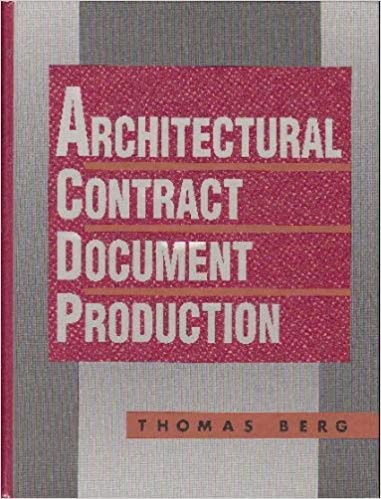
Architectural Contract Document Production
0
0
As an Amazon Associate and affiliate partner, Menrva Books earns from qualifying purchases. Learn more
Author Description
Nearly 60 to 70 percent of a typical architectural fee is spent on document and drawing production, so if this effort is poorly done, the project usually loses money. But unlike other "how-to" drawing books, this unique book will help guide the architect, the draftsman, the interior designer, the landscape architect, the design engineer, and anyone else engaged in difficult and time-consuming work of generating project drawings and documents better understand the "why" of this process, the proper sequence of drawing preparation, standards to refer to, how to coordinate different drawings at different points in the design and production stages of a project, and how to effectively maintain quality control over these documents. Also included will be extremely useful information on reprographics, computer-aided drawing and drawing storage.
Menrva's Summary
THE THESIS
This text investigates the financial and operational necessity of optimizing architectural document production to prevent project losses. Authors Darla G. Berg and Thomas Berg provide a comprehensive framework for understanding the logic behind drawing sequences, documentation standards, and interdisciplinary coordination. The book serves as a guide for design professionals to improve efficiency and maintain rigorous quality control throughout the production lifecycle.
THE SCOPE MAP
What You Will Find
- Methodologies for coordinating drawings across design and production stages
- Standards for document preparation and quality control protocols
- Technical guidance on reprographics and computer-aided drawing systems
- Best practices for long-term drawing storage and management
Scope Limits
- Does not cover architectural design theory or aesthetic principles
- Does not provide specific software tutorials for CAD or BIM applications
THE AUTHORITY PERSPECTIVE
Professionals in the field frequently cite this work as a practical reference for managing the labor-intensive aspects of architectural practice. Experts highlight the text for its focus on the procedural 'why' behind documentation rather than just the technical 'how'.
Page Count:
459
Publication Date:
1991-01-01
Publisher:
McGraw-Hill
ISBN-10:
0070048576
ISBN-13:
9780070048577
Architecture
Architecture
Reference
New Used & Rental Textbooks
Engineering
Professional Practice
Community Tags
Similar Books