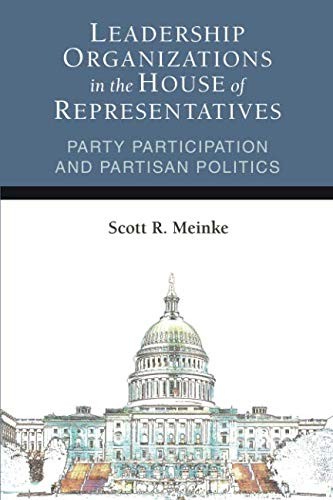
Leadership Organizations in the House of Representatives
0
0
As an Amazon Associate and affiliate partner, Menrva Books earns from qualifying purchases. Learn more
Author Description
In recent Congresses, roughly half of the members of the U.S. House of Representatives served in whip organizations and on party committees. Rank-and-file representatives who use party service to advance their own careers benefit from this growing rate of participation in the party hierarchy, as do the party leaders who use participation in order to advance the party's agenda through coordination, communication, and persuasion. According to Scott R. Meinke, however, rising electoral competition and polarization over the past 40 years have altered the nature of party participation. In the 1970s and 1980s, the participation of a wide range of members was crucial to building consensus. Since then, in the partisan battle for control of the chamber, organizations responsible for coordination in the party have become dominated by those who follow the party line. At the same time, key leaders in the House use participatory organizations less as forums for internal deliberations over policy and strategy than as channels for exchanging information with supporters outside Congress and broadcasting sharply partisan campaign messages to the public. This transformation of leadership organizations generally serves a party's collective goals in an era of close electoral competition and ideological polarization. Yet it also hinders a party's ability to reach a strategic consensus over divisive issues and to develop its own policy alternatives. -- from back cover.
Menrva's Summary
THE THESIS
This book investigates how leadership organizations within the U.S. House of Representatives have evolved due to increased electoral competition and polarization over the past four decades. Scott R. Meinke argues that while these changes have enabled parties to better coordinate and communicate their agendas, they have also diminished the capacity for internal consensus-building on divisive issues and the development of alternative policy proposals. The analysis focuses on the shift from consensus-building in the 1970s and 1980s to a more top-down, information-exchange model in contemporary Congresses.
THE SCOPE MAP
- Analysis of the role of whip organizations and party committees in recent Congresses.
- Examination of how rank-and-file representatives use party service for career advancement.
- Exploration of how party leaders utilize participation to advance the party's agenda.
- Discussion of the impact of rising electoral competition and polarization on party participation.
- Comparison of party participation strategies in the 1970s-1980s versus contemporary eras.
- Investigation into the use of participatory organizations as channels for external communication and partisan messaging.
- Assessment of the trade-offs between party coordination and internal deliberation over divisive issues.
THE AUTHORITY PERSPECTIVE
The book examines the transformation of leadership organizations in the House of Representatives, detailing how increased electoral competition and polarization have shifted their function from consensus-building to information exchange and partisan messaging. Meinke's analysis suggests that while these changes serve collective party goals in a competitive environment, they also create challenges for internal deliberation and policy development. The work provides a historical perspective on these organizational shifts within the U.S. Congress.
Page Count:
244
Publication Date:
2019-01-01
ISBN-10:
047203734X
ISBN-13:
9780472037346
Art
Non-Fiction
Science
Politics
American Politics
Legislative Process
Community Tags
Similar Books