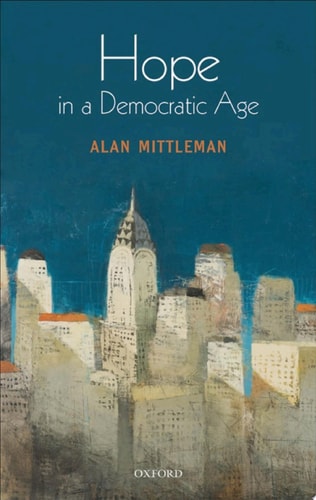
Hope in a Democratic Age: Philosophy, Religion, and Political Theory
0
0
As an Amazon Associate and affiliate partner, Menrva Books earns from qualifying purchases. Learn more
Author Description
How and why should hope play a key role in a twenty-first century democratic politics? Alan Mittleman offers a philosophical exploration of the theme, contending that a modern construction of hope as an emotion is deficient. He revives the medieval understanding of hope as a virtue, reconstructing this in a contemporary philosophical idiom. In this framework, hope is less a spontaneous reaction than it is a choice against despair; a decision to live with confidence and expectation, based on a rational assessment of possibility and a faith in the underlying goodness of life. In cultures shaped by biblical teaching, hope is thought praiseworthy. Mittleman explores the religious origins of the concept of hope in the Hebrew Scriptures, New Testament, rabbinic literature and Augustine. He traces the roots of both the praise of hope, in Jewish and Christian thought, and the criticism of hope in Greco-Roman thought and in the tradition of philosophical pessimism. Arguing on behalf of a straightened, sober form of hope, he relates hope-as-a-virtue to the tasks of democratic citizenship. Without diminishing the wisdom found in tragedy, a strong argument emerges in favour of hope as a way of taking responsibility for the world. Drawing on insights from scriptural and classical texts, philosophers, and theologians - ancient and modern, Mittleman builds a compelling case for placing hope at the centre of democratic political systems.
Menrva's Summary
THE THESIS
This work investigates how the concept of hope, when reconstructed as a virtue rather than a mere emotion, can serve as a foundational element for democratic political systems in the twenty-first century. Alan Mittleman, a scholar of Jewish philosophy and religion, utilizes a multidisciplinary approach to critique the modern reduction of hope to a spontaneous feeling. By synthesizing insights from biblical texts, rabbinic literature, and classical philosophy, he argues that hope functions as a rational, deliberate choice to engage with the world despite the presence of tragedy and philosophical pessimism.
THE SCOPE MAP
What You Will Find
- A historical analysis of hope in Hebrew Scriptures, the New Testament, and rabbinic tradition.
- A comparative study of Greco-Roman skepticism versus Judeo-Christian optimism.
- A philosophical framework for hope as a virtue essential to democratic citizenship.
- An examination of the tension between philosophical pessimism and political responsibility.
Scope Limits
- The text does not provide a practical policy manual for democratic governance.
- The analysis is primarily focused on Western traditions and does not cover non-Western political or religious perspectives on hope.
THE AUTHORITY PERSPECTIVE
Scholars and readers frequently note the academic density of the prose and the author's rigorous engagement with complex theological and philosophical sources. Experts highlight this as a significant contribution to the intersection of political theory and religious ethics, suitable for those interested in the intellectual foundations of democratic life.
Page Count:
307
Publication Date:
2009-01-01
Publisher:
OUP Oxford
ISBN-10:
0191608858
ISBN-13:
9780191608858
Religion
Political Philosophy
Democratic Theory
Political Theory
Theology
Ethics
Community Tags
Similar Books