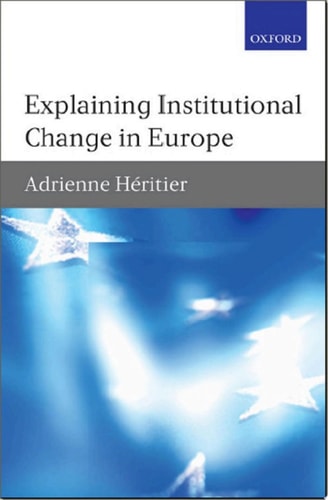
Explaining Institutional Change in Europe
0
0
As an Amazon Associate and affiliate partner, Menrva Books earns from qualifying purchases. Learn more
Author Description
How and why do institutions change? Institutions, understood as rules of behaviour constraining and facilitating social interaction, are subject to different forms and processes of change. A change may be designed intentionally on a large scale and then be followed by a period of only incremental adjustments to new conditions. But institutions may also emerge as informal rules, persist for a long time and only be formalized later. Why? The causes, processes and outcomes of institutional change raise a number of conceptual, theoretical and empirical questions. While we know a lot about the creation of institutions, relatively little research has been conducted about their transformation once they have been put into place. Attention has focused on politically salient events of change, such as the Intergovernmental Conferences of Treaty reform. In focussing on such grand events, we overlook inconspicuous changes of European institutional rules that are occurring on a daily basis. Thus, the European Parliament has gradually acquired a right of investing individual Commissioners. This has never been an issue in the negotiations of formal treaty revisions. Or, the decision-making rule(s) under which the European Parliament participates in the legislative process have drastically changed over the last decades starting from a modest consultation ending up with codecision. The book discusses various theories accounting for long-term institutional change and explores them on the basis of five important institutional rules in the European Union. It proposes typical sequences of long-term institutional change and their theorization which hold for other contexts as well, if the number of actors and their goals are clearly defined, and interaction takes place under the "shadow of the future".
Menrva's Summary
THE THESIS
This book investigates the mechanisms and causal processes that drive institutional change within the European Union, specifically focusing on how rules evolve beyond initial creation. Adrienne Héritier, a prominent scholar in European governance, addresses the gap in political science research regarding the transformation of established institutions. She argues that while grand treaty reforms receive significant attention, incremental and informal changes are equally critical to understanding institutional development. By analyzing five specific institutional rules, the author provides a theoretical framework for identifying typical sequences of change that occur under the influence of actor goals and the shadow of the future.
THE SCOPE MAP
What You Will Find
- Theoretical models of long-term institutional evolution
- Analysis of five specific institutional rules within the European Union
- Conceptualization of incremental versus intentional change
Scope Limits
- Does not provide a comprehensive history of all EU institutions
- Focuses primarily on formal and informal rule-based changes rather than broader cultural shifts
THE AUTHORITY PERSPECTIVE
Experts recognize this work as a significant contribution to the study of European integration and institutional theory. Readers frequently note the academic density of the prose, which is intended for advanced students and researchers in political science.
Page Count:
282
Publication Date:
2007-01-01
Publisher:
OUP Oxford
ISBN-10:
0191608882
ISBN-13:
9780191608889
European Union
Governance
European Economic Community
Decision Making
Public Policy
Social change
Community Tags
Other Editions(4)



Similar Books

Reader Comments
Share Your Thoughts
No comments yet. Be the first to share your thoughts!