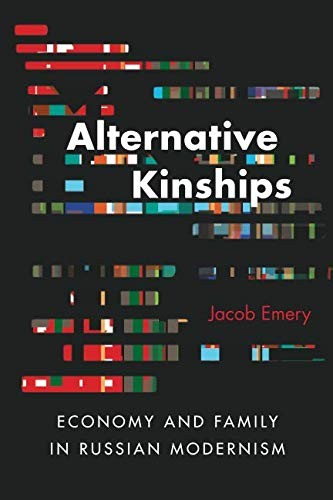
Alternative Kinships
0
0
As an Amazon Associate and affiliate partner, Menrva Books earns from qualifying purchases. Learn more
Author Description
According to Marx, the family is the primal scene of the division of labor and the "germ" of every exploitative practice. In this insightful study, Jacob Emery examines the Soviet Union's programmatic effort to institute a global siblinghood of the proletariat, revealing how alternative kinships motivate different economic relations and make possible other artistic forms. A time in which literary fiction was continuous with the social fictions that organize the social economy, the early Soviet period magnifies the interaction between the literary imagination and the reproduction of labor onto a historical scale. Narratives dating back to the ancient world feature scenes in which a child looks into a mirror and sees someone else reflected there, typically a parent. In such scenes, two definitions of the aesthetic coincide: art as a fantastic space that shows an alternate reality and art as a mirror that reflects the world as it is. In early Soviet literature, mirror scenes illuminate the intersection of imagination and economy, yielding new relations destined to replace biological kinship relations based in food, language, or spirit. These metaphorical kinships have explanatory force far beyond their context, providing a vantage point onto, for example, the Gothic literature of the early United States and the science fiction discourses of the postwar period. "Alternative Kinships" will appeal to scholars of Russian literature, comparative literature, and literary theory, as well as those interested in reconciling formalist and materialist approaches to culture.
Menrva's Summary
THE THESIS
The book investigates the Soviet Union's attempt to redefine kinship structures as a means of economic and social transformation. Jacob Emery examines how the early Soviet period utilized literary fiction and social narratives to construct a global siblinghood of the proletariat, challenging traditional biological and familial ties. The study explores how these alternative kinships motivated different economic relations and fostered distinct artistic forms, particularly through the analysis of
THE SCOPE MAP
- Analysis of Soviet programmatic efforts to institute a global siblinghood of the proletariat.
- Examination of how alternative kinships influenced economic relations and artistic production.
- Exploration of the early Soviet period as a time when literary fiction was continuous with social fictions organizing the economy.
- Focus on "mirror scenes" in literature as illuminating the intersection of imagination and economy.
- Discussion of how metaphorical kinships replaced biological kinship based on food, language, or spirit.
- Application of these concepts to Gothic literature of the early United States and postwar science fiction discourses.
- Target audience includes scholars of Russian literature, comparative literature, and literary theory.
- Reconciliation of formalist and materialist approaches to culture.
THE AUTHORITY PERSPECTIVE
This insightful study by Jacob Emery offers a rigorous examination of the intersection between literature, economics, and social structures in the early Soviet period. By analyzing how alternative kinship models were constructed and propagated, the book provides a unique lens through which to understand the relationship between cultural production and economic ideology. The work is positioned to appeal to specialists in Russian and comparative literature, as well as those interested in broader theoretical discussions of culture and materialism.
Page Count:
194
Publication Date:
2017-01-01
ISBN-10:
0875807801
ISBN-13:
9780875807805
Non-Fiction
History
Literary theory
Russian
Marxism
Comparative
Social History
Community Tags
Similar Books