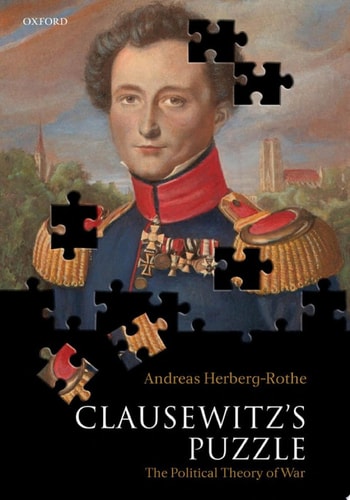
Clausewitz's Puzzle: The Political Theory of War
0
0
As an Amazon Associate and affiliate partner, Menrva Books earns from qualifying purchases. Learn more
Author Description
Blending detailed contextual analysis with issues in modern-day international relations this book provides a major new analysis of the theory of Clausewitz and its relevance to contemporary society. This book argues that Clausewitz developed a wide-ranging political theory of war by reflecting on the success, the limitations, and the failure of Napoleon's method of waging war, a theory, which is still relevant in light of contemporary conflict. This new interpretation is the result of reflecting on Clausewitz's theory in light of the new developments and lays down the foundation of a general theory of war by concentrating on Clausewitz's historical analyses of war campaigns. For the first time analysis of three paradigmatic military campaigns is placed at the centre of understanding surrounding Clausewitz's 'On War': The author argues that the limitations of Napoleon's strategy, as revealed in Russia and in his final defeat, enabled Clausewitz to develop a general theory of war. This book is a project of the Oxford Leverhulme Programme on the Changing Character of War.
Menrva's Summary
THE THESIS
This book investigates the core question of how Clausewitz’s historical observations on Napoleonic warfare form a coherent, enduring political theory of conflict relevant to modern international relations. Andreas Herberg-Rothe, a scholar associated with the Oxford Leverhulme Programme on the Changing Character of War, utilizes a rigorous re-examination of Clausewitz’s primary texts. He argues that the Prussian strategist’s work is not merely a military manual but a comprehensive political framework derived from the successes and failures of Napoleon Bonaparte.
THE SCOPE MAP
What You Will Find
- A detailed analysis of three paradigmatic military campaigns including the Russian campaign and Napoleon's final defeat.
- A re-interpretation of 'On War' as a political theory rather than a purely tactical guide.
- An application of historical military analysis to contemporary global conflict scenarios.
Scope Limits
- The text does not provide a comprehensive biography of Clausewitz.
- It does not focus on modern technological advancements in weaponry or cyber warfare.
THE AUTHORITY PERSPECTIVE
Scholars and military historians recognize this work as a significant contribution to the re-evaluation of Clausewitzian thought in the post-Cold War era. Readers frequently note the academic density of the prose, which is intended for those already familiar with the foundational concepts of strategic studies.
Page Count:
201
Publication Date:
2007-01-01
Publisher:
OUP Oxford
ISBN-10:
0191607061
ISBN-13:
9780191607066
Philosophy
Military Science
War Theory
International relations
Military History
Community Tags
Similar Books