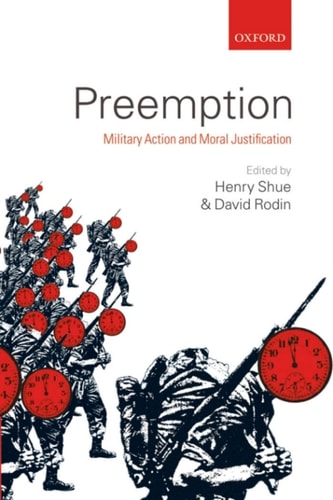
Preemption: Military Action and Moral Justification
0
0
As an Amazon Associate and affiliate partner, Menrva Books earns from qualifying purchases. Learn more
Author Description
The dramatic declaration by U.S. President George W. Bush that, in light of the attacks on 9/11, the United States would henceforth be engaging in "preemption" against such enemies as terrorists armed with weapons of mass destruction forced a wide-open debate about justifiable uses of military force. Opponents saw the declaration as a direct challenge to the consensus, which has formed since the ratification of the Charter of the United Nations, that armed force may be used only in defense. Supporters responded that in an age of terrorism defense could only mean "preemption." This volume of all-new chapters provides the historical, legal, political, and philosophical perspective necessary to intelligent participation in the on-going debate, which is likely to last long beyond the war in Iraq. Thorough defenses and critiques of the Bush doctrine are provided by the most authoritative writers on the subject from both sides of the Atlantic. Is a nation ever justified in attacking before it has been attacked? If so, under precisely what conditions? Does the possibility of terrorists with weapons of mass destruction force us to change our traditional views about what counts as defense? This book provides the most comprehensive assessment to date of the justifiability of preemptive or preventive military action. Its engaging debate, accompanied by an analytic Introduction, focuses probing criticism against the most persuasive proponents of preemptive attack or preventive war, who then respond to these challenges and modify or extend their justifications. Authors of recent pivotal analyses, including historian Marc Trachtenberg, international relations professor Neta Crawford, law professor David Luban, and political philosopher Allen Buchanan, are confronted by other authoritative writers on the nature and justification of war more broadly, including historian Hew Strachan, international normative theorist Henry Shue, and philosophers David Rodin, Walter Sinnott-Armstrong
Menrva's Summary
THE THESIS
This volume investigates the moral, legal, and political legitimacy of preemptive military action in the context of modern global security threats. Edited by David Rodin and Henry Shue, the text assembles a diverse group of historians, legal scholars, and philosophers to evaluate whether the traditional United Nations framework regarding self-defense remains sufficient in an era of non-state terrorism and weapons of mass destruction. The contributors provide a structured debate, offering both rigorous defenses and critical rebuttals of the doctrine of preemption.
THE SCOPE MAP
What You Will Find
- Historical analysis of the evolution of international norms regarding armed force.
- Philosophical frameworks for evaluating the morality of preventive versus preemptive war.
- Legal critiques concerning the United Nations Charter and state sovereignty.
- Direct point-counterpoint exchanges between prominent scholars on the Bush doctrine.
Scope Limits
- The text does not provide a definitive policy manual for current military operations.
- It focuses primarily on the theoretical and normative foundations rather than tactical military strategy.
THE AUTHORITY PERSPECTIVE
Experts identify this work as a foundational text for understanding the intellectual climate surrounding post-9/11 security policies. Readers frequently note the academic density of the prose, which requires a strong background in political philosophy or international law to fully synthesize the arguments presented.
Page Count:
276
Publication Date:
2007-01-01
Publisher:
Oxford University Press
ISBN-10:
0191528447
ISBN-13:
9780191528446
Philosophy
Ethics
War
Military Science
War and Conflict
International Security
International relations
Military History
Community Tags
Similar Books