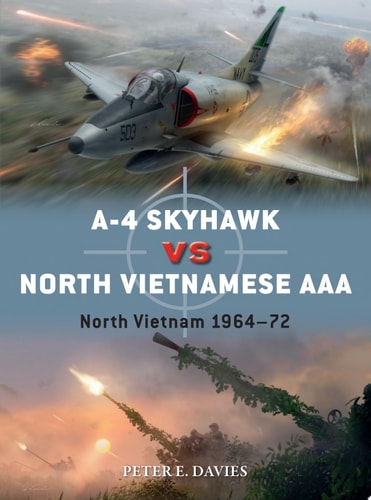
A-4 Skyhawk vs North Vietnamese AAA: North Vietnam 1964–72
0
0
As an Amazon Associate and affiliate partner, Menrva Books earns from qualifying purchases. Learn more
Author Description
While the F105 Thunderchief was the USAF's principal strike weapon during the Rolling Thunder campaign, the US Navy relied on the Douglas A-4 Skyhawk for the majority of its strikes on North Vietnam. The Skyhawk entered service in 1956 and remained in continuous production for 26 years. Throughout Operation Rolling Thunder it was the US Navy's principal daytime light strike bomber, remaining in use after its replacement, the more sophisticated A-7 Corsair II, began to appear in December 1967. During the 1965–68 Rolling Thunder period, up to five attack carriers regularly launched A-4 strike formations against North Vietnam. These formations faced an ever-expanding and increasingly coordinated Soviet-style network of anti-aircraft artillery missiles and fighters. Skyhawk pilots were often given the hazardous task of attacking anti-aircraft defences and to improve accuracy, they initially dropped ordnance below 3000 ft in a 30-degree dive in order to bomb visually below the persistent low cloud over North Vietnam, putting the aircraft within range of small-arms fire. The defenders had the advantage of covering a relatively small target area, and the sheer weight of light, medium and heavy gunfire directed at an attacking force brought inevitable casualties, and a single rifle bullet could have the same effect as a larger shell. This illustrated title examines both the A-4 Skyhawk and the Vietnamese AAA defences in context, exploring their history and analysing their tactics and effectiveness during the conflict.
Menrva's Summary
THE THESIS
This book examines the aerial combat between the US Navy's A-4 Skyhawk and North Vietnam's anti-aircraft artillery (AAA) defenses during the Vietnam War. The Douglas A-4 Skyhawk served as the US Navy's primary light strike bomber during Operation Rolling Thunder, facing an increasingly coordinated Soviet-style network of AAA, missiles, and fighters. Skyhawk pilots often undertook the dangerous mission of attacking these defenses, initially dropping ordnance below 3000 ft in a 30-degree dive to bomb visually below persistent low cloud cover, which placed them within range of small-arms fire. The defenders, covering a relatively small target area, directed a heavy volume of gunfire at attacking forces, making even a single rifle bullet as potentially damaging as a larger shell.
THE SCOPE MAP
- Detailed history and analysis of the Douglas A-4 Skyhawk's role in strikes against North Vietnam.
- Examination of the Soviet-style anti-aircraft artillery (AAA) network and its evolution.
- Analysis of the tactics employed by both the A-4 Skyhawk pilots and the Vietnamese AAA defenses.
- Discussion of the effectiveness and challenges faced by both sides during the conflict.
- Coverage of the period from 1964 to 1972, focusing on Operation Rolling Thunder.
- Exploration of the specific dangers faced by Skyhawk pilots, including small-arms fire and the impact of AAA.
- Comparison of the A-4 Skyhawk with its successor, the A-7 Corsair II.
THE AUTHORITY PERSPECTIVE
This illustrated title examines both the A-4 Skyhawk and the Vietnamese AAA defenses in context, exploring their history and analyzing their tactics and effectiveness during the conflict. The book details the Skyhawk's role as the US Navy's principal daytime light strike bomber during Operation Rolling Thunder. It highlights the hazardous task given to Skyhawk pilots of attacking anti-aircraft defenses, often at low altitudes. The work also analyzes the defenders' tactics and the effectiveness of their increasingly coordinated Soviet-style network of anti-aircraft artillery, missiles, and fighters.
Page Count:
80
Publication Date:
2020-09-17
Publisher:
Bloomsbury Publishing
ISBN-10:
1472840801
ISBN-13:
9781472840806
Non-Fiction
History
Vietnam War
Military History
Aviation
Community Tags
Similar Books