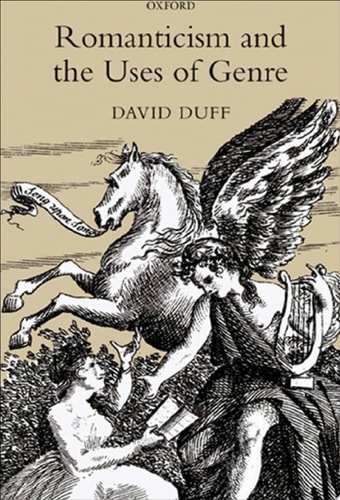
Romanticism and the Uses of Genre
0
0
As an Amazon Associate and affiliate partner, Menrva Books earns from qualifying purchases. Learn more
Author Description
This wide-ranging and original book reappraises the role of genre, and genre theory, in British Romanticism. Analyzing numerous examples from 1760 to 1830, David Duff examines the generic innovations and experiments which propel the Romantic 'revolution in literature', but also the fascination with archaic forms such as the ballad, sonnet, and romance, whose revival and transformation make Romanticism a 'retro' movement as well as a revolutionary one. The tension between the drives to 'make it old' and to 'make it new' generates one of the most dynamic phases in the history of literature, whose complications are played out in the critical writing of the period as well as its creative literature. Incorporating extensive research on classification systems and reception history as well as on literary forms themselves, Romanticism and the Uses of Genre demonstrates how new ideas about the role and status of genre influenced not only authors but also publishers, editors, reviewers, and readers. The focus is on poetry, but a wider spectrum of genres is considered, a central theme being the relationship - hierarchical, competitive, combinatory - between genres. Among the topics addressed are generic primitivism and forgery; Enlightenment theory and the 'cognitive turn'; the impact of German transcendental aesthetics; organic and anti-organic form; the role of genre in the French Revolution debate; the poetics of the fragment; and the theory and practice of genre-mixing. Unprecedented in its scope and detail, this important book establishes a new way of reading Romantic literature which brings into focus for the first time its tangled relationship with genre.
Menrva's Summary
THE THESIS
This book investigates how the tension between archaic revivalism and innovative experimentation defined the generic landscape of British Romanticism between 1760 and 1830. David Duff, a scholar of Romantic literature, utilizes extensive research into historical classification systems, reception history, and contemporary critical writing to argue that genre was a central, rather than peripheral, force in the period's literary evolution. He posits that the Romantic movement functioned simultaneously as a revolutionary force and a 'retro' movement, with authors actively negotiating the status and hierarchy of literary forms.
THE SCOPE MAP
What You Will Find
- Analysis of generic innovations including the ballad, sonnet, and romance.
- Examination of the impact of German transcendental aesthetics and Enlightenment theory.
- Discussion of the poetics of the fragment and the practice of genre-mixing.
- Historical context regarding the French Revolution debate and its influence on literary form.
Scope Limits
- The primary focus remains on poetry, though other genres are considered.
- The study is geographically and chronologically confined to British literature between 1760 and 1830.
THE AUTHORITY PERSPECTIVE
Scholars recognize this work as a significant contribution to the study of Romanticism, particularly for its detailed examination of how genre theory influenced publishers and readers alongside authors. Readers frequently note the academic density of the prose, which serves as a rigorous resource for those interested in the formal mechanics of the period.
Page Count:
271
Publication Date:
2009-01-01
Publisher:
OUP Oxford
ISBN-10:
0191610208
ISBN-13:
9780191610202
Poetry
English
Romanticism
Literary Criticism
British literature
Genre Theory
Literary Form
English literature
Literary History
English & College Success
Community Tags
Similar Books