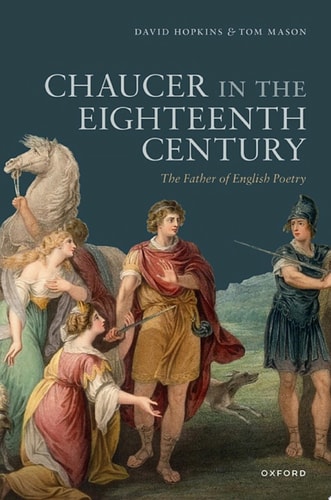
Chaucer in the Eighteenth Century: The Father of English Poetry
0
0
As an Amazon Associate and affiliate partner, Menrva Books earns from qualifying purchases. Learn more
Author Description
This volume is a study of how the poetry of Chaucer continued to give pleasure in the eighteenth century despite the immense linguistic, literary, and cultural shifts that had occurred in the intervening centuries. It explores translations and imitations of Chaucer's work by Dryden, Pope, and other poets (including Samuel Cobb, John Dart, Christopher Smart, Jane Brereton, William Wordsworth, and Leigh Hunt) from the early eighteenth to the early nineteenth centuries, as well as investigating the beginnings of modern Chaucer editing and biography. It pays particular attention to critical responses to Chaucer by Dryden and the brothers Warton, and includes a chapter on the oblique presence of Chaucer in Samuel Johnson's Dictionary. It explores the ways in which Chaucer's poetry (including several works now known not to be by him) was described, refashioned, reimagined, and understood several centuries after its initial appearance. It also documents the way that views of Chaucer's own character were inferred from his work. The book combines detailed discussion of particular critical and poetic texts, many of them unfamiliar to modern readers, with larger suggestions about the ways in which poetry of the past is received in the future.
Menrva's Summary
THE THESIS
This volume investigates how Geoffrey Chaucer’s poetry maintained its relevance and aesthetic appeal during the eighteenth century despite significant linguistic and cultural transformations. The authors, David A. Hopkins and Tom Mason, utilize a wide array of primary sources, including translations, imitations, and critical essays, to demonstrate how Enlightenment-era writers engaged with medieval texts. By examining the editorial and biographical practices of the period, the authors argue that the eighteenth-century reception of Chaucer was foundational to the modern understanding of his work.
THE SCOPE MAP
What You Will Find
- Analysis of Chaucerian translations and imitations by figures such as Dryden, Pope, and Wordsworth.
- Examination of early modern editorial practices and biographical construction.
- Investigation of Chaucer’s presence in Samuel Johnson’s Dictionary.
- Discussion of the reception of apocryphal works attributed to Chaucer during the period.
Scope Limits
- The study focuses primarily on the eighteenth and early nineteenth centuries, excluding contemporary or medieval-specific analysis.
- It does not provide a comprehensive biography of Chaucer himself, but rather a history of his reception.
THE AUTHORITY PERSPECTIVE
Scholars frequently cite this work as a definitive resource for understanding the transition of medieval literature into the Enlightenment canon. Experts highlight the book's meticulous archival research and its ability to synthesize complex critical responses from a diverse range of eighteenth-century poets and lexicographers.
Page Count:
734
Publication Date:
2022-01-01
Publisher:
OUP Oxford
ISBN-10:
0192676946
ISBN-13:
9780192676948
Poetry
18th century
English literature
English
Literary History
English & College Success
Literary Criticism
Community Tags
Similar Books