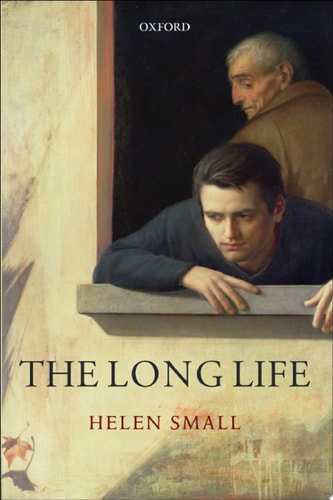
The Long Life
0
0
As an Amazon Associate and affiliate partner, Menrva Books earns from qualifying purchases. Learn more
Author Description
The Long Life invites the reader to range widely from the writings of Plato through to recent philosophical work by Derek Parfit, Bernard Williams, and others, and from Shakespeare's King Lear through works by Thomas Mann, Balzac, Dickens, Beckett, Stevie Smith, Philip Larkin, to more recent writing by Saul Bellow, Philip Roth, and J. M. Coetzee. Helen Small argues that if we want to understand old age, we have to think more fundamentally about what it means to be a person, to have a life, to have (or lead) a good life, to be part of a just society. What did Plato mean when he suggested that old age was the best place from which to practice philosophy - or Thomas Mann when he defined old age as the best time to be a writer - and were they right? If we think, as Aristotle did, that a good life requires the active pursuit of virtue, how will our view of later life be affected? If we think that lives and persons are unified, much as stories are said to be unified, how will our thinking about old age differ from that of someone who thinks that lives and/or persons can be strongly discontinuous? In a just society, what constitutes a fair distribution of limited resources between the young and the old? How, if at all, should recent developments in the theory of evolutionary senescence alter our thinking about what it means to grow old? This is a groundbreaking book, deep as well as broad, and likely to alter the way in which we talk about one of the great social concerns of our time - the growing numbers of those living to be old, and the growing proportion of the old to the young.
Menrva's Summary
THE THESIS
This work investigates the philosophical, ethical, and social implications of aging by examining how historical and contemporary thinkers define the value and structure of a human life. Helen H. Small, a scholar of English literature, synthesizes perspectives from classical philosophy, canonical literature, and modern social theory to challenge existing assumptions about the later stages of life. She argues that understanding old age requires a fundamental re-evaluation of personhood, the concept of a unified life, and the obligations of a just society toward its aging population.
THE SCOPE MAP
What You Will Find
- Philosophical inquiries into the nature of virtue and the good life as defined by Aristotle and his successors.
- Literary analysis of aging through works by Shakespeare, Thomas Mann, Balzac, Dickens, Beckett, and J. M. Coetzee.
- Ethical frameworks regarding the distribution of resources between generations in a modern society.
- Scientific considerations concerning evolutionary senescence and its impact on human self-perception.
Scope Limits
- The text does not provide a clinical or medical guide to the physical processes of aging.
- It does not offer specific policy recommendations or legislative solutions for social security or healthcare systems.
THE AUTHORITY PERSPECTIVE
Scholars and critics frequently note the intellectual density of the prose, which bridges the gap between humanities-based literary analysis and rigorous philosophical inquiry. Experts highlight this as a significant contribution to the field of gerontology, particularly for its ability to contextualize the aging experience within the broader history of Western thought.
Page Count:
361
Publication Date:
2010-01-01
Publisher:
OUP Oxford
ISBN-10:
0191615579
ISBN-13:
9780191615573
Philosophy
Non-Fiction
In literature
Ethics
English & College Success
English
Literary Criticism
Sociology
Gerontology
Community Tags
Similar Books