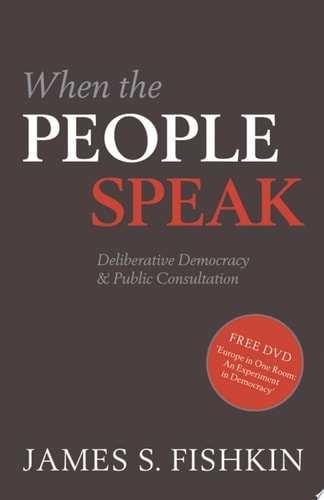
When the People Speak: Deliberative Democracy and Public Consultation
0
0
As an Amazon Associate and affiliate partner, Menrva Books earns from qualifying purchases. Learn more
Author Description
All over the world democratic reforms have brought power to the people-but under conditions where the people have little opportunity to think about the power that they exercise. Do we want a democracy inspired by Madison or by Madison Avenue? A democracy animated by deliberation or by manipulation? This book examines each of the principal democratic theories and makes the case for a democracy in which the people offer informed judgments about politics or policy. It then goes on to show how this form of democracy can be made a reality. When the People Speak describes deliberative democracy projects conducted by the author with various collaborators in the US, China, Britain, Denmark, Australia, Italy, Bulgaria, Northern Ireland, and in the entire European Union. These projects have resulted in the massive expansion of wind power in Texas, the building of sewage treatment plants to China, the crafting of budget solutions in a region in Italy, and greater mutual understanding between Catholics and Protestants in Northern Ireland. The book is accompanied by a DVD of "Europe in One Room" by Emmy Award documentary makers Paladin Invision in London. The film recounts one of the most challenging deliberative democracy efforts with a scientific sample from 27 countries speaking 21 languages. Critics of deliberative democracy say that it will privilege the more educated or that the public is incompetent when it comes to understanding policy issues, and should not be consulted. Others argue that it will increase polarization. Fishkin offers rebuttals for each of these arguments. Combining theory and practice he shows how a more deliberative politics is both practical and compelling.
Menrva's Summary
THE THESIS
This book investigates whether modern democratic systems can move beyond superficial public opinion polling toward a model of deliberative democracy where citizens provide informed judgments on complex policy issues. James S. Fishkin, a professor of political science and director of the Center for Deliberative Democracy, utilizes his extensive experience conducting deliberative polling projects across diverse global contexts. He argues that by creating structured environments for informed discussion, societies can mitigate the influence of manipulation and polarization in political decision-making.
THE SCOPE MAP
What You Will Find
- Theoretical frameworks comparing Madisonian democracy with deliberative models
- Empirical evidence from deliberative projects in the US, China, Britain, and the European Union
- Rebuttals to common critiques regarding public incompetence and elite bias
- Practical methodologies for implementing large-scale public consultation
Scope Limits
- The text focuses primarily on the author's specific deliberative polling methodology rather than a broad history of all democratic reform movements
- It does not provide an exhaustive analysis of every existing form of participatory democracy
THE AUTHORITY PERSPECTIVE
Experts recognize this work as a foundational text for understanding the practical application of deliberative democracy in contemporary governance. Readers frequently note the balance between rigorous political theory and the detailed, real-world case studies provided by the author.
Page Count:
254
Publication Date:
2009-01-01
Publisher:
OUP Oxford
ISBN-10:
0191610151
ISBN-13:
9780191610158
Sociology
Democracy
Governance
Public Policy