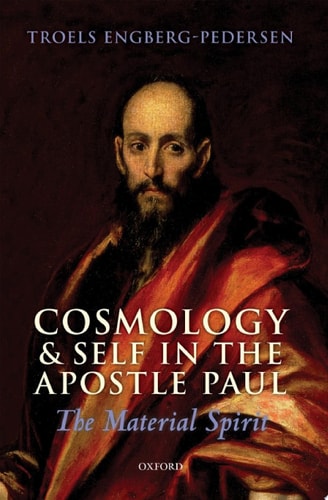
Cosmology and Self in the Apostle Paul: The Material Spirit
0
0
As an Amazon Associate and affiliate partner, Menrva Books earns from qualifying purchases. Learn more
Author Description
Cosmology and Self in the Apostle Paul challenges the traditional reading of Paul. Troels Engberg-Pedersen argues that the usual, mainly cognitive and metaphorical, ways of understanding central Pauline concepts, such as 'being in Christ', 'having God's pneuma (spirit), Christ's pneuma, and Christ himself in one', must be supplemented by a literal understanding that directly reflects Paul's cosmology. Engberg-Pedersen shows that Paul's cosmology, not least his understanding of the pneuma, was a materialist, bodily one: the pneuma was a physical element that would at the resurrection act directly on the ordinary human bodies of believers and transform them into 'pneumatic bodies'. This literal understanding of the future events is then traced back to the Pauline present as Engberg-Pedersen considers how Paul conceived in bodily terms of a range of central themes like his own conversion, his mission, the believers' reception of the pneuma in baptism, and the way the apostle took the pneuma to inform his own and their ways of life from the beginning to the projected end. In developing this picture of Paul's world view, an explicitly philosophically oriented form of interpretation ('philosophical exegesis') is employed, in which the interpreter applies categories of interpretation that make sense philosophically, whether in an ancient or a modern context. For this enterprise Engberg-Pedersen draws in particular on ancient Stoic materialist and monistic physics and cosmology - as opposed to the Platonic, immaterialist and dualistic categories that underlie traditional readings of Paul - and on modern ideas on 'religious experience', 'self', 'body' and 'practice' derived from Foucault and Bourdieu. In this way Paul is shown to have spelled out philosophically his Jewish, 'apocalyptic' world view, which remains a central feature of his thought. The book states the cosmological case for the author's earlier 'ethical' reading of Paul in his prize-winning book, Paul and the Stoics.
Menrva's Summary
THE THESIS
This book investigates whether the central concepts of Pauline theology, specifically the nature of the spirit (pneuma) and the believer's union with Christ, should be interpreted as literal, materialist phenomena rather than purely metaphorical or cognitive constructs. Troels Engberg-Pedersen, a scholar of New Testament and ancient philosophy, utilizes a framework of 'philosophical exegesis' to re-examine Paul's writings. By contrasting traditional Platonic, dualistic interpretations with ancient Stoic materialist physics, the author argues that Paul viewed the pneuma as a physical element capable of transforming human bodies at the resurrection. This materialist reading is then applied to Paul's understanding of conversion, baptism, and the daily practice of the early Christian community.
THE SCOPE MAP
What You Will Find
- A comparative analysis between Stoic materialist monism and Platonic immaterialist dualism in the context of Pauline theology.
- An examination of the role of the pneuma in the resurrection and the transformation of the human body.
- Integration of modern sociological and philosophical concepts from Foucault and Bourdieu regarding the self, body, and religious practice.
- A re-evaluation of Paul's Jewish apocalyptic worldview through a philosophical lens.
Scope Limits
- The text does not provide a comprehensive historical biography of Paul, focusing instead on his cosmological and philosophical framework.
- The analysis does not address non-Pauline New Testament literature or later patristic developments.
THE AUTHORITY PERSPECTIVE
Scholars and students of theology frequently note the academic density and rigorous philosophical methodology employed throughout the text. Experts highlight this work as a significant contribution to the ongoing debate regarding the intersection of ancient philosophy and early Christian thought.
Page Count:
304
Publication Date:
2010-01-01
Publisher:
OUP Oxford
ISBN-10:
019161579X
ISBN-13:
9780191615795
Philosophy
Religion
Theology
Community Tags
Similar Books